![http://UPSC%20coaching%20in%20India%20-%20Best%20UPSC%20coaching%20institute%20-%20UPSC%20Mentor%20coaching%20-%20UPSC%20preparation%20institute%20-%20IAS%20coaching%20center%20-%20UPSC%20online%20coaching%20-%20Best%20IAS%20coaching%20in%20India%20-%20UPSC%20classes%20for%20beginners%20-%20Civil%20services%20preparation%20-%20IAS%20preparation%20institute%20-%20UPSC%20mentorship%20program%20-%20UPSC%20exam%20guidance%20-%20IAS%20study%20material%20-%20UPSC%20Prelims%20coaching%20-%20UPSC%20Mains%20coaching%20-%20UPSC%20interview%20preparation%20-%20Best%20IAS%20online%20classes%20-%20UPSC%20coaching%20with%20personal%20mentorship%20-%20Affordable%20UPSC%20coaching%20-%20UPSC%20test%20series%20-%20UPSC%20coaching%20near%20me%20-%20Best%20IAS%20coaching%20near%20me%20-%20UPSC%20institute%20in%20[your%20city]%20-%20IAS%20coaching%20center%20in%20[your%20city]%20-%20The%20UPSC%20Mentor%20coaching%20-%20The%20UPSC%20Mentor%20IAS%20classes%20-%20The%20UPSC%20Mentor%20UPSC%20course%20-%20UPSC%20Mentor%20online%20program.](https://theupscmentor.in/wp-content/uploads/2024/11/THE-UPSC-2-e1762319162137.png)
 admin
admin Source: The Indian Express
Context: Biodiversity loss, Western Ghats
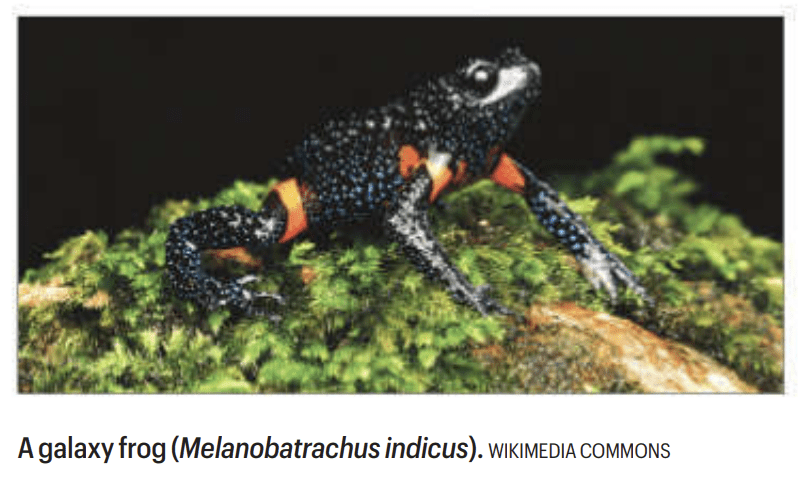
0.1 About the galaxy frog
0.1.1 Galaxy frogs (Melanobatrachus indicus) are among the rarest amphibians in the world.
0.1.2 They live exclusively under rotten logs in Kerala’s Western Ghats, making them extremely habitat-specific and sensitive to disturbance.
0.2 Scientific discovery and monitoring
0.2.1 In March 2020, researchers discovered seven galaxy frogs in a forest patch in the Western Ghats.
0.2.2 The finding was part of a long-term monitoring programme conducted with approval from the Kerala Forest Department.
0.3 Why the species is extremely vulnerable
0.3.1 Galaxy frogs do not produce mating calls, unlike most frog species.
0.3.2 Scientists believe they rely on visual signals, which makes tracking population size and breeding behaviour extremely difficult.
0.3.3 The species is already classified as vulnerable to extinction due to its restricted range and specialised habitat.
0.4 Rise of photo tourism after discovery
0.4.1 After the discovery became public, wildlife photographers began visiting the site between June 2020 and April 2021.
0.4.2 Many photographers had precise knowledge of the frogs’ micro-habitat, obtained through trackers and publicly shared information.
0.5 How photography disturbed the habitat
0.5.1 Photographers overturned logs, handled frogs by hand, and used high-powered flashes for extended periods.
0.5.2 Such repeated disturbance likely interfered with the frogs’ feeding, shelter use, and breeding behaviour.
0.6 Evidence of disappearance
0.6.1 When researchers revisited the site in August 2021, they found displaced logs and trampled vegetation.
0.6.2 Follow-up surveys in November 2021 and May 2022 failed to locate any galaxy frogs at the site.
0.7 Study’s conclusion
0.7.1 All seven galaxy frogs recorded in 2020 are now presumed dead.
0.7.2 The study identifies unregulated photo tourism as a new and serious threat to rare and highly sensitive wildlife species.
![UPSC coaching in India - Best UPSC coaching institute - UPSC Mentor coaching - UPSC preparation institute - IAS coaching center - UPSC online coaching - Best IAS coaching in India - UPSC classes for beginners - Civil services preparation - IAS preparation institute - UPSC mentorship program - UPSC exam guidance - IAS study material - UPSC Prelims coaching - UPSC Mains coaching - UPSC interview preparation - Best IAS online classes - UPSC coaching with personal mentorship - Affordable UPSC coaching - UPSC test series - UPSC coaching near me - Best IAS coaching near me - UPSC institute in [your city] - IAS coaching center in [your city] - The UPSC Mentor coaching - The UPSC Mentor IAS classes - The UPSC Mentor UPSC course - UPSC Mentor online program.](https://theupscmentor.in/wp-content/uploads/2025/11/cropped-THE-UPSC-1.png)