![http://UPSC%20coaching%20in%20India%20-%20Best%20UPSC%20coaching%20institute%20-%20UPSC%20Mentor%20coaching%20-%20UPSC%20preparation%20institute%20-%20IAS%20coaching%20center%20-%20UPSC%20online%20coaching%20-%20Best%20IAS%20coaching%20in%20India%20-%20UPSC%20classes%20for%20beginners%20-%20Civil%20services%20preparation%20-%20IAS%20preparation%20institute%20-%20UPSC%20mentorship%20program%20-%20UPSC%20exam%20guidance%20-%20IAS%20study%20material%20-%20UPSC%20Prelims%20coaching%20-%20UPSC%20Mains%20coaching%20-%20UPSC%20interview%20preparation%20-%20Best%20IAS%20online%20classes%20-%20UPSC%20coaching%20with%20personal%20mentorship%20-%20Affordable%20UPSC%20coaching%20-%20UPSC%20test%20series%20-%20UPSC%20coaching%20near%20me%20-%20Best%20IAS%20coaching%20near%20me%20-%20UPSC%20institute%20in%20[your%20city]%20-%20IAS%20coaching%20center%20in%20[your%20city]%20-%20The%20UPSC%20Mentor%20coaching%20-%20The%20UPSC%20Mentor%20IAS%20classes%20-%20The%20UPSC%20Mentor%20UPSC%20course%20-%20UPSC%20Mentor%20online%20program.](https://theupscmentor.in/wp-content/uploads/2024/11/THE-UPSC-2-e1762319162137.png)
 admin
admin 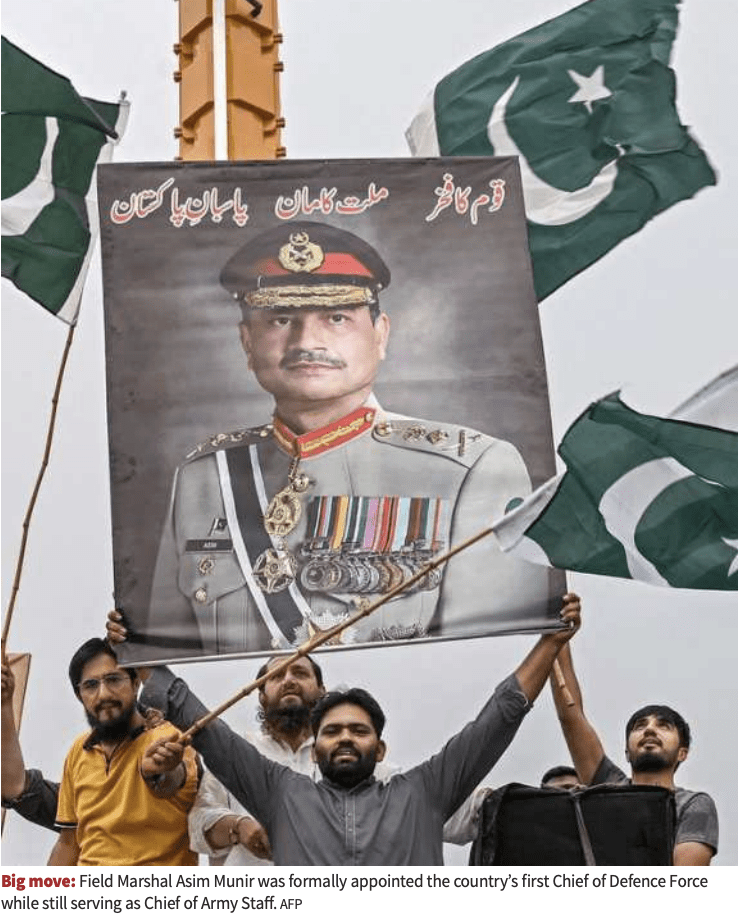
0.1 Core pattern in Pakistan’s political history
0.1.1 Pakistan’s political history shows a recurring pattern where civilian governments struggle to assert authority amid weak institutions and deep social divisions.
0.1.2 The appointment of Asim Munir as Chief of Defence Force (CDF) reflects continuity, not rupture, in how power operates in Pakistan.
0.2 Recent consolidation of military authority
0.2.1 In December 2025, Asim Munir was formally appointed CDF while still serving as Chief of Army Staff, a move described as familiar yet unsettling.
0.2.2 Constitutional amendments quietly expanded executive and military authority, reduced judicial oversight, and centralised power without an overt military takeover.
0.3 Historical roots of military dominance
0.3.1 Since 1947, Pakistan experienced extreme political instability, with seven Prime Ministers in its first 11 years.
0.3.2 Ethnic, linguistic, and regional divisions—especially the imposition of Urdu as the national language—deepened political fractures and weakened civilian cohesion.
0.4 Coups as institutional solutions to governance crises
0.4.1 Military interventions under Ayub Khan, Yahya Khan, and Zia-ul-Haq were justified as responses to civilian failure, disorder, or national crisis.
0.4.2 Each intervention strengthened the military’s role as the ultimate arbiter of political order, even when followed by civilian governments.
0.5 Zia era and long-term structural damage
0.5.1 Zia-ul-Haq’s long rule entrenched authoritarian discipline, ideological control, and jihadist networks.
0.5.2 Economic growth during this period was driven largely by foreign aid and external conflicts, not domestic institutional strength.
0.5.3 Zia’s legacy continues to shape Pakistan’s security doctrine and political culture.
0.6 Civilian governments under military shadow
0.6.1 From Benazir Bhutto to Nawaz Sharif, elected governments faced systematic constraints, frequent dismissals, and limited autonomy.
0.6.2 Civil–military tension remained a defining feature, with no Prime Minister completing a full term between 2008 and 2018.
0.7 The Imran Khan episode and its aftermath
0.7.1 Imran Khan rose to power in 2018 with implicit military backing but faced resistance once he attempted autonomy.
0.7.2 He was removed through a no-confidence vote, later entangled in legal cases, jailed, and politically marginalised.
0.7.3 Despite continued popular support, electoral success did not translate into sustained political power.
0.8 Why the cycle persists
0.8.1 Persistent civilian weakness, corruption, ethnic divisions, radicalisation, and geopolitical entanglements sustain military dominance.
0.8.2 The military remains Pakistan’s most cohesive institution, operating as a constant presence behind every government.
0.8.3 Without institutional rebuilding and civilian strengthening, political instability and military control are likely to continue.
![UPSC coaching in India - Best UPSC coaching institute - UPSC Mentor coaching - UPSC preparation institute - IAS coaching center - UPSC online coaching - Best IAS coaching in India - UPSC classes for beginners - Civil services preparation - IAS preparation institute - UPSC mentorship program - UPSC exam guidance - IAS study material - UPSC Prelims coaching - UPSC Mains coaching - UPSC interview preparation - Best IAS online classes - UPSC coaching with personal mentorship - Affordable UPSC coaching - UPSC test series - UPSC coaching near me - Best IAS coaching near me - UPSC institute in [your city] - IAS coaching center in [your city] - The UPSC Mentor coaching - The UPSC Mentor IAS classes - The UPSC Mentor UPSC course - UPSC Mentor online program.](https://theupscmentor.in/wp-content/uploads/2025/11/cropped-THE-UPSC-1.png)