![http://UPSC%20coaching%20in%20India%20-%20Best%20UPSC%20coaching%20institute%20-%20UPSC%20Mentor%20coaching%20-%20UPSC%20preparation%20institute%20-%20IAS%20coaching%20center%20-%20UPSC%20online%20coaching%20-%20Best%20IAS%20coaching%20in%20India%20-%20UPSC%20classes%20for%20beginners%20-%20Civil%20services%20preparation%20-%20IAS%20preparation%20institute%20-%20UPSC%20mentorship%20program%20-%20UPSC%20exam%20guidance%20-%20IAS%20study%20material%20-%20UPSC%20Prelims%20coaching%20-%20UPSC%20Mains%20coaching%20-%20UPSC%20interview%20preparation%20-%20Best%20IAS%20online%20classes%20-%20UPSC%20coaching%20with%20personal%20mentorship%20-%20Affordable%20UPSC%20coaching%20-%20UPSC%20test%20series%20-%20UPSC%20coaching%20near%20me%20-%20Best%20IAS%20coaching%20near%20me%20-%20UPSC%20institute%20in%20[your%20city]%20-%20IAS%20coaching%20center%20in%20[your%20city]%20-%20The%20UPSC%20Mentor%20coaching%20-%20The%20UPSC%20Mentor%20IAS%20classes%20-%20The%20UPSC%20Mentor%20UPSC%20course%20-%20UPSC%20Mentor%20online%20program.](https://theupscmentor.in/wp-content/uploads/2024/11/THE-UPSC-2-e1762319162137.png)
 admin
admin 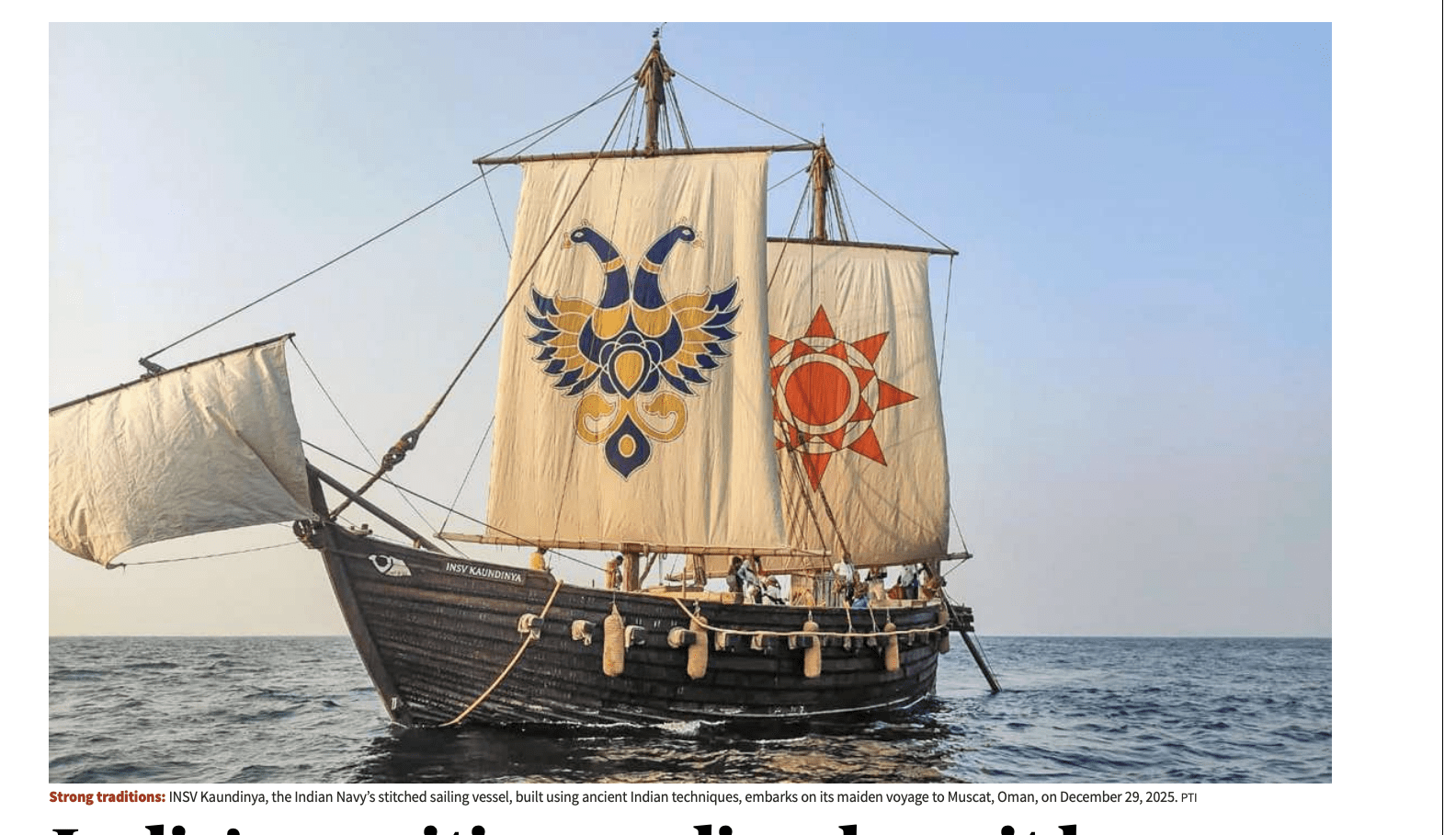
0.1 Why India’s maritime policy matters
0.1.1 India’s geography is defined by two dominant features: the Himalayas and the Indian Ocean, both shaping its history and strategic outlook.
0.1.2 While land routes shaped invasions and empires, the sea enabled trade, cultural exchange, and outward engagement.
0.1.3 India’s maritime policy reflects how it understands power, security, and connectivity in the Indian Ocean region.
0.2 Historical foundations of India’s maritime outlook
0.2.1 Ancient and medieval India had strong maritime traditions, with Indian sailors reaching West Asia and Southeast Asia.
0.2.2 Maritime capability was a source of economic prosperity and political influence.
0.2.3 Jawaharlal Nehru emphasised that control of the Indian Ocean directly affects India’s trade and security.
0.3 Intellectual framing in the Routledge Handbook
0.3.1 The Routledge Handbook of Maritime India offers a multidimensional analysis of India’s maritime evolution.
0.3.2 The handbook links history, strategy, economics, and technology to India’s maritime choices.
0.3.3 It treats India’s maritime policy as evolving alongside geopolitical shifts.
0.4 India’s outward maritime reach through history
0.4.1 Essays trace India’s maritime expansion through the Cholas, Marathas, Arabs, and Europeans.
0.4.2 N. Manoharan describes the Cholas as the “Nautical Tigers”, highlighting early power projection.
0.4.3 K. M. Panikkar’s ideas are revisited for their continued relevance to contemporary geopolitics.
0.5 Reframing the Indian Ocean
0.5.1 Varun Sahni argues the Indian Ocean should not be seen merely as a transit space.
0.5.2 It should be viewed as a human space, home to dense populations and settlements.
0.5.3 This reframing strengthens India’s responsibility toward regional stability and governance.
0.6 Evolution of India’s maritime strategy
0.6.1 The book documents India’s maritime relations with Australia, Japan, France, Pakistan, Bangladesh, Sri Lanka, Maldives, Myanmar, Thailand, Indonesia, and China.
0.6.2 India successfully demarcated maritime boundaries with most neighbours, except Pakistan.
0.6.3 Delays with Pakistan are attributed to “motivated assumptions”, as per Huo Wen’s analysis.
0.7 Managing maritime rivalry with China
0.7.1 Huo Wen’s chapter explores Sino-Indian maritime rivalry.
0.7.2 It highlights risks of clashing interests in shared maritime spaces.
0.7.3 The chapter recommends rules of engagement and structured dialogue to prevent zero-sum outcomes.
0.8 India’s role in regional maritime governance
0.8.1 Comparative analysis of India and China’s maritime security governance reveals growing risks.
0.8.2 Zou Zhengxin points to dangers of zero-sum competition, intensified by U.S. influence.
0.8.3 Joint consultative mechanisms are recommended to stabilise maritime development.
0.9 South Asian maritime weaknesses
0.9.1 R. Srinivasan highlights governance failures in Sri Lanka, including corruption and clan politics.
0.9.2 Weak leadership pushes states toward China’s Belt and Road Initiative (BRI).
0.9.3 This undermines sound maritime governance in South Asia.
0.10 India’s maritime power projection
0.10.1 India has performed well in maritime power projection since the early 2000s.
0.10.2 The Indian Navy played a crucial role in curbing piracy in the Arabian Sea.
0.10.3 This marked the Navy’s transition from an observer to a net security provider.
0.11 Competing strategic visions
0.11.1 One view supports a hedging strategy, aligning with U.S. Indo-Pacific thinking.
0.11.2 Another advocates strengthening India’s maritime presence to build political and economic confluence with like-minded powers.
0.11.3 These debates shape India’s evolving Indo-Pacific posture.
0.12 Indo-Pacific strategy under strain
0.12.1 India’s Indo-Pacific focus has dominated discourse for two decades.
0.12.2 Recent global crises — Ukraine, Gaza, Iran, Red Sea, Venezuela — have diluted attention.
0.12.3 The National Security Strategy (NSS) 2025 adopts a softer view of China as an economic competitor.
0.13 Need to refine India’s Indo-Pacific approach
0.13.1 India must reassess how it positions China within its maritime strategy.
0.13.2 The evolving geopolitical environment demands strategic recalibration.
0.13.3 The handbook argues this issue deserves separate and focused debate.
0.14 Emerging maritime domains and future priorities
0.14.1 The final chapters address economic and technological transformations at sea.
0.14.2 Key areas include underwater domain awareness (UDA), maritime security systems, and the Blue Economy.
0.14.3 Climate resilience and coastal security are treated as central policy pillars.
0.15 Blue Economy and strategic integration
0.15.1 The Blue Economy is presented as both an economic and strategic opportunity.
0.15.2 Maritime development must integrate security, sustainability, and technology.
0.15.3 India’s long-term maritime success depends on this integration.
0.16 Policy relevance and takeaway
0.16.1 India’s maritime policy has shifted from historical neglect to strategic centrality.
0.16.2 The Indian Ocean is no longer peripheral but core to India’s global role.
0.16.3 The handbook’s recommendations merit serious consideration by policymakers.
![UPSC coaching in India - Best UPSC coaching institute - UPSC Mentor coaching - UPSC preparation institute - IAS coaching center - UPSC online coaching - Best IAS coaching in India - UPSC classes for beginners - Civil services preparation - IAS preparation institute - UPSC mentorship program - UPSC exam guidance - IAS study material - UPSC Prelims coaching - UPSC Mains coaching - UPSC interview preparation - Best IAS online classes - UPSC coaching with personal mentorship - Affordable UPSC coaching - UPSC test series - UPSC coaching near me - Best IAS coaching near me - UPSC institute in [your city] - IAS coaching center in [your city] - The UPSC Mentor coaching - The UPSC Mentor IAS classes - The UPSC Mentor UPSC course - UPSC Mentor online program.](https://theupscmentor.in/wp-content/uploads/2025/11/cropped-THE-UPSC-1.png)