![http://UPSC%20coaching%20in%20India%20-%20Best%20UPSC%20coaching%20institute%20-%20UPSC%20Mentor%20coaching%20-%20UPSC%20preparation%20institute%20-%20IAS%20coaching%20center%20-%20UPSC%20online%20coaching%20-%20Best%20IAS%20coaching%20in%20India%20-%20UPSC%20classes%20for%20beginners%20-%20Civil%20services%20preparation%20-%20IAS%20preparation%20institute%20-%20UPSC%20mentorship%20program%20-%20UPSC%20exam%20guidance%20-%20IAS%20study%20material%20-%20UPSC%20Prelims%20coaching%20-%20UPSC%20Mains%20coaching%20-%20UPSC%20interview%20preparation%20-%20Best%20IAS%20online%20classes%20-%20UPSC%20coaching%20with%20personal%20mentorship%20-%20Affordable%20UPSC%20coaching%20-%20UPSC%20test%20series%20-%20UPSC%20coaching%20near%20me%20-%20Best%20IAS%20coaching%20near%20me%20-%20UPSC%20institute%20in%20[your%20city]%20-%20IAS%20coaching%20center%20in%20[your%20city]%20-%20The%20UPSC%20Mentor%20coaching%20-%20The%20UPSC%20Mentor%20IAS%20classes%20-%20The%20UPSC%20Mentor%20UPSC%20course%20-%20UPSC%20Mentor%20online%20program.](https://theupscmentor.in/wp-content/uploads/2024/11/THE-UPSC-2-e1762319162137.png)
 admin
admin 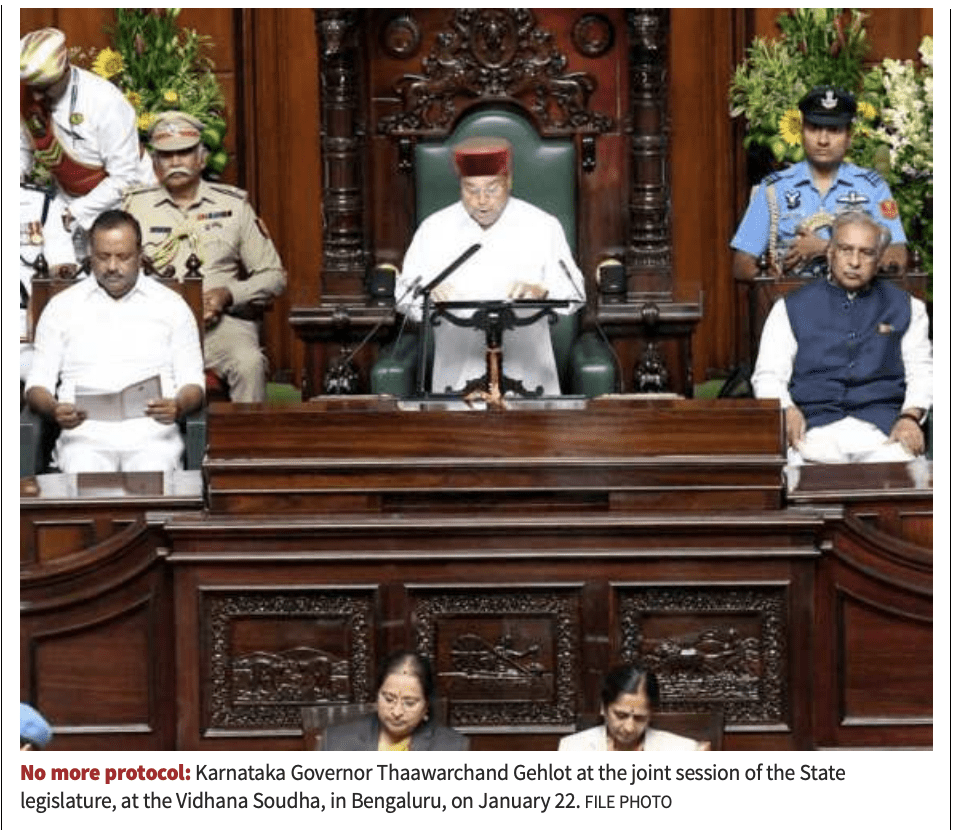
0.1 Context
0.1.1 There have been repeated disputes in Opposition-ruled States regarding the Governor’s address to the State Legislature.
0.1.2 These disputes arise at the commencement of the first session of the year, raising constitutional and political questions about the Governor’s role.
0.2 Historical Background
0.2.1 Under Section 63 of the Government of India Act, 1935, the Governor had discretion to address the provincial legislature.
0.2.2 From 1937 onwards, the Governor’s speech was prepared in consultation with the Council of Ministers, reflecting the legislative agenda.
0.2.3 In the Constituent Assembly, it was clearly understood that the Governor’s address would reflect the policy of the elected government, not personal views.
0.3 Constitutional Provisions: Article 175
0.3.1 Article 175 allows the Governor to address either House or both Houses of the State Legislature.
0.3.2 This address is not mandatory and is rarely used by a ruling government.
0.3.3 The function is largely procedural, not discretionary.
0.4 Constitutional Provisions: Article 176
0.4.1 Article 176 mandates that the Governor shall address the Legislature:
0.4.1.1 At the commencement of the first session after each general election, and
0.4.1.2 At the commencement of the first session of each year.
0.4.2 This is a mandatory address.
0.4.3 The address must be prepared by the Council of Ministers, not by the Governor personally.
0.4.4 The address outlines the government’s achievements and policy roadmap.
0.5 Legislative Procedure After the Address
0.5.1 Article 176 directs the Legislature to regulate the procedure for discussion on the address.
0.5.2 The discussion takes the form of a Motion of Thanks.
0.5.3 Members debate the policies announced in the address before voting on the motion.
0.6 Judicial Interpretation of the Governor’s Role
0.6.1 The Supreme Court has held that the Governor is a constitutional head.
0.6.2 The Governor must act on the aid and advice of the Council of Ministers while performing functions under Articles 175 and 176.
0.6.3 The Governor cannot substitute the elected government’s views with personal opinions.
0.7 Current Issues in Practice
0.7.1 In some Opposition-ruled States, Governors have acted against established constitutional practice.
0.7.2 In Tamil Nadu, portions of the address were skipped in 2022 and 2023.
0.7.3 In 2024, the Governor failed to address the Assembly as required under Article 176.
0.7.4 In Kerala, parts of the address prepared by the Cabinet were skipped.
0.7.5 In Karnataka, the Governor did not read the Cabinet-prepared address and instead delivered his own two-line address before leaving the joint session.
0.8 Constitutional Oath and Governor’s Duty
0.8.1 Governors take an oath under Article 159.
0.8.2 The oath requires them to preserve, protect and defend the Constitution and the law.
0.8.3 Acting contrary to the advice of the elected government violates settled constitutional principles.
0.9 Nature of the Conflict
0.9.1 Conflicts between Governors and elected governments have existed since the 1960s.
0.9.2 However, recent instances show greater frequency and intensity.
0.9.3 The underlying issue is the politicisation of the Governor’s office.
0.10 Federalism and Democratic Concerns
0.10.1 The Governor acts as the nominal head of the State executive, similar to the President at the Union level.
0.10.2 Federalism is a basic feature of the Constitution.
0.10.3 The Governor’s office should not undermine the authority of popularly elected governments.
0.11 Recommendations and Reform Options
0.11.1 The Sarkaria Commission and Punchhi Commission recommended reforms to reduce friction.
0.11.2 One key recommendation is consultation with the Chief Minister before appointing a Governor.
0.11.3 While abolition of the post has been suggested, it is unlikely in a quasi-federal system.
0.11.4 Implementing Commission recommendations is seen as a practical reform path.
![UPSC coaching in India - Best UPSC coaching institute - UPSC Mentor coaching - UPSC preparation institute - IAS coaching center - UPSC online coaching - Best IAS coaching in India - UPSC classes for beginners - Civil services preparation - IAS preparation institute - UPSC mentorship program - UPSC exam guidance - IAS study material - UPSC Prelims coaching - UPSC Mains coaching - UPSC interview preparation - Best IAS online classes - UPSC coaching with personal mentorship - Affordable UPSC coaching - UPSC test series - UPSC coaching near me - Best IAS coaching near me - UPSC institute in [your city] - IAS coaching center in [your city] - The UPSC Mentor coaching - The UPSC Mentor IAS classes - The UPSC Mentor UPSC course - UPSC Mentor online program.](https://theupscmentor.in/wp-content/uploads/2025/11/cropped-THE-UPSC-1.png)