![http://UPSC%20coaching%20in%20India%20-%20Best%20UPSC%20coaching%20institute%20-%20UPSC%20Mentor%20coaching%20-%20UPSC%20preparation%20institute%20-%20IAS%20coaching%20center%20-%20UPSC%20online%20coaching%20-%20Best%20IAS%20coaching%20in%20India%20-%20UPSC%20classes%20for%20beginners%20-%20Civil%20services%20preparation%20-%20IAS%20preparation%20institute%20-%20UPSC%20mentorship%20program%20-%20UPSC%20exam%20guidance%20-%20IAS%20study%20material%20-%20UPSC%20Prelims%20coaching%20-%20UPSC%20Mains%20coaching%20-%20UPSC%20interview%20preparation%20-%20Best%20IAS%20online%20classes%20-%20UPSC%20coaching%20with%20personal%20mentorship%20-%20Affordable%20UPSC%20coaching%20-%20UPSC%20test%20series%20-%20UPSC%20coaching%20near%20me%20-%20Best%20IAS%20coaching%20near%20me%20-%20UPSC%20institute%20in%20[your%20city]%20-%20IAS%20coaching%20center%20in%20[your%20city]%20-%20The%20UPSC%20Mentor%20coaching%20-%20The%20UPSC%20Mentor%20IAS%20classes%20-%20The%20UPSC%20Mentor%20UPSC%20course%20-%20UPSC%20Mentor%20online%20program.](https://theupscmentor.in/wp-content/uploads/2024/11/THE-UPSC-2-e1762319162137.png)
 admin
admin 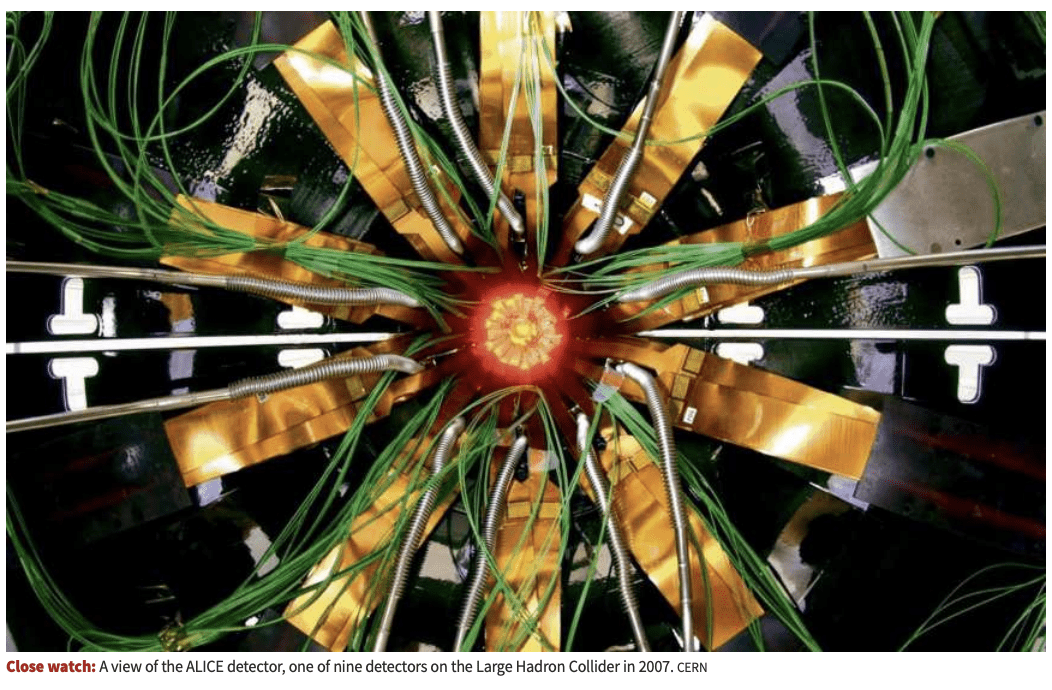
1. The Core Puzzle
1.1 The deuteron is a light and fragile nucleus made of one proton and one neutron.
1.2 It has very low binding energy, meaning it can easily break apart.
1.3 At CERN’s Large Hadron Collider (LHC), particles collide at nearly the speed of light, creating extremely violent conditions.
1.4 Despite this, experiments repeatedly observe deuterons and anti-deuterons after collisions.
1.5 This creates a key scientific question: How do such fragile nuclei survive high-energy collisions?
2. Why This Question Is Important
2.1 Similar high-energy collisions occur in space when cosmic rays strike interstellar gas.
2.2 To correctly interpret cosmic-ray data, scientists must understand how light nuclei form.
2.3 Without this knowledge, signals related to cosmic rays or dark matter could be misinterpreted.
3. Competing Explanations for Deuteron Formation
3.1 Direct formation hypothesis
3.1.1 Deuterons are formed at the instant of collision.
3.1.2 Problem: the collision environment is too violent for such a fragile nucleus to survive.
3.2 Coalescence hypothesis
3.2.1 Protons and neutrons are produced first as separate particles.
3.2.2 They later combine gently when the collision environment cools slightly.
3.2.3 This process occurs away from the most violent region, improving survival chances.
4. What the CERN–ALICE Experiment Studied
4.1 The study was conducted using the ALICE detector at CERN.
4.2 Scientists tracked a short-lived excited particle called the Δ (delta) resonance.
4.3 This resonance decays into protons or neutrons and pions.
4.4 By studying momentum correlations, scientists identified when deuterons were formed.
5. Key Finding of the Study
5.1 The experiment showed that nearly 80% of deuterons form after the collision, not during it.
5.2 This provides strong evidence for the coalescence mechanism.
5.3 In simple terms, deuterons are assembled later, rather than surviving the initial explosion.
6. Why Deuterons Are Able to Survive
6.1 Formation occurs after the most violent phase of the collision.
6.2 This protects the deuteron from immediate destruction.
6.3 Even a fragile nucleus can exist in extreme environments if it forms at the right time.
7. Broader Scientific Significance
7.1 Helps build realistic models of cosmic-ray interactions.
7.2 Improves interpretation of anti-nuclei signals detected in space.
7.3 Resolves a long-standing puzzle in nuclear physics.
8. One-Line Conceptual Takeaway
8.1 Deuterons survive high-energy collisions because they form after the collision through coalescence, not during it.
![UPSC coaching in India - Best UPSC coaching institute - UPSC Mentor coaching - UPSC preparation institute - IAS coaching center - UPSC online coaching - Best IAS coaching in India - UPSC classes for beginners - Civil services preparation - IAS preparation institute - UPSC mentorship program - UPSC exam guidance - IAS study material - UPSC Prelims coaching - UPSC Mains coaching - UPSC interview preparation - Best IAS online classes - UPSC coaching with personal mentorship - Affordable UPSC coaching - UPSC test series - UPSC coaching near me - Best IAS coaching near me - UPSC institute in [your city] - IAS coaching center in [your city] - The UPSC Mentor coaching - The UPSC Mentor IAS classes - The UPSC Mentor UPSC course - UPSC Mentor online program.](https://theupscmentor.in/wp-content/uploads/2025/11/cropped-THE-UPSC-1.png)