![http://UPSC%20coaching%20in%20India%20-%20Best%20UPSC%20coaching%20institute%20-%20UPSC%20Mentor%20coaching%20-%20UPSC%20preparation%20institute%20-%20IAS%20coaching%20center%20-%20UPSC%20online%20coaching%20-%20Best%20IAS%20coaching%20in%20India%20-%20UPSC%20classes%20for%20beginners%20-%20Civil%20services%20preparation%20-%20IAS%20preparation%20institute%20-%20UPSC%20mentorship%20program%20-%20UPSC%20exam%20guidance%20-%20IAS%20study%20material%20-%20UPSC%20Prelims%20coaching%20-%20UPSC%20Mains%20coaching%20-%20UPSC%20interview%20preparation%20-%20Best%20IAS%20online%20classes%20-%20UPSC%20coaching%20with%20personal%20mentorship%20-%20Affordable%20UPSC%20coaching%20-%20UPSC%20test%20series%20-%20UPSC%20coaching%20near%20me%20-%20Best%20IAS%20coaching%20near%20me%20-%20UPSC%20institute%20in%20[your%20city]%20-%20IAS%20coaching%20center%20in%20[your%20city]%20-%20The%20UPSC%20Mentor%20coaching%20-%20The%20UPSC%20Mentor%20IAS%20classes%20-%20The%20UPSC%20Mentor%20UPSC%20course%20-%20UPSC%20Mentor%20online%20program.](https://theupscmentor.in/wp-content/uploads/2024/11/THE-UPSC-2-e1762319162137.png)
 admin
admin 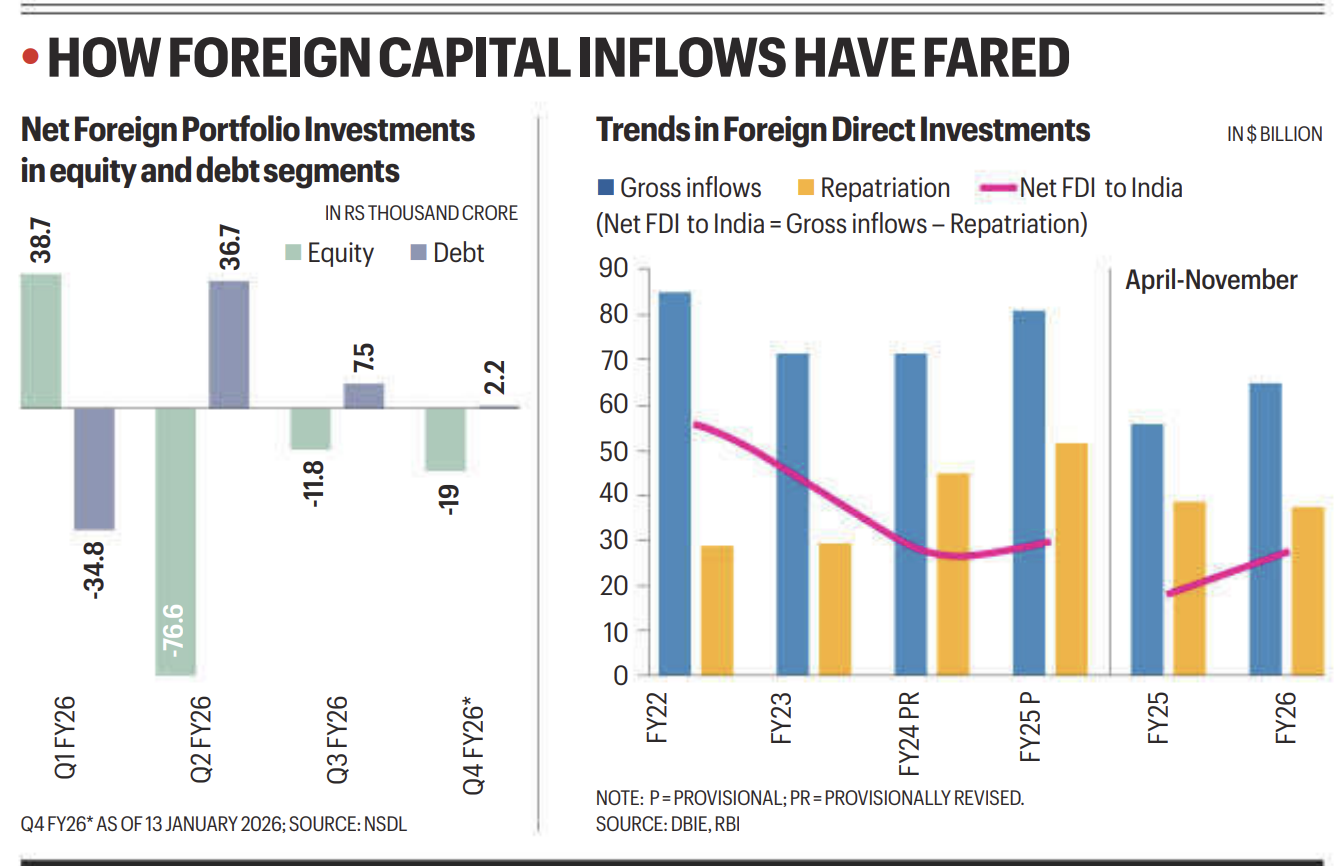
0.0 Context of the Article
0.0.1 The article is based on the Economic Survey 2025–26.
0.0.2 It analyses the reasons behind the rupee hitting a low of ₹91.98 per US dollar.
0.1 Survey’s Assessment of Rupee Performance
0.1.1 The Survey states that the rupee has been affected by capital outflows.
0.1.2 It says the rupee’s “underperformance” does not accurately reflect India’s stellar economic fundamentals.
0.1.3 The rupee is described as “punching below its weight”.
0.1.4 The Survey attributes this primarily to external factors.
0.2 India’s Domestic Economic Conditions
0.2.1 India has recorded strong economic growth.
0.2.2 The outlook is described as favourable.
0.2.3 Inflation is controlled.
0.2.4 Rainfall and agricultural prospects are supportive.
0.3 Impact of Global Political and Economic Turmoil
0.3.1 India has become a “victim of geopolitics”.
0.3.2 The Survey notes that global political and economic turmoil may manifest with a lag.
0.3.3 India faces risks of contraction in liquidity.
0.3.4 There is a risk of disruption of capital flows.
0.3.5 These factors can have a consequent impact on the rupee.
0.4 Dependence on Foreign Capital Flows
0.4.1 India depends on foreign capital flows to maintain a healthy balance of payments.
0.4.2 When foreign capital flows run drier, rupee stability becomes a casualty.
0.5 Foreign Portfolio Investment (FPI) Outflows
0.5.1 The rupee has been underperforming against the dollar amid sustained FPI outflows.
0.5.2 Foreign portfolio investors have withdrawn $4 billion so far in January.
0.5.3 The total FPI outflow in 2025 amounted to $11.8 billion.
0.6 Role of Domestic Institutional Investors
0.6.1 Domestic institutional investors, particularly mutual funds and insurance companies, have counterbalanced these outflows.
0.6.2 Their actions have supported the markets.
0.7 Valuation of the Rupee
0.7.1 The Survey states that an undervalued rupee does not hurt in the current situation.
0.7.2 It offsets to some extent the impact of higher American tariffs on Indian goods.
0.7.3 There is no threat of higher inflation from higher-priced crude oil imports at the moment.
0.7.4 However, the Survey notes that investors do pause.
0.7.5 Investors show reluctance to commit to India without examination.
0.8 US Tariff Pressure on Exports
0.8.1 The observations come at a time when exports could come under pressure due to steep 50% US tariffs.
0.8.2 While the impact on outbound shipments has been limited so far,
0.8.3 Exporters have said that fresh orders from the US have stopped coming in.
0.8.4 Continued tariffs could cause irreversible damage.
0.9 Manufacturing and Currency Strength
0.9.1 To achieve currency strength, India must raise manufacturing strength.
0.9.2 Currency strength depends on industrial capacity.
0.9.3 Across successful industrialisers, complex manufacturing-led export growth preceded improvements in
0.9.3.1 current accounts
0.9.3.2 reserves
0.9.3.3 exchange-rate credibility
1.0 Limits of Services and Remittances
1.0.1 India has a net trade surplus in services and remittances.
1.0.2 This is not enough to offset the trade deficit in goods.
1.0.3 Services exports work best as a complement, not a substitute, for manufacturing.
![UPSC coaching in India - Best UPSC coaching institute - UPSC Mentor coaching - UPSC preparation institute - IAS coaching center - UPSC online coaching - Best IAS coaching in India - UPSC classes for beginners - Civil services preparation - IAS preparation institute - UPSC mentorship program - UPSC exam guidance - IAS study material - UPSC Prelims coaching - UPSC Mains coaching - UPSC interview preparation - Best IAS online classes - UPSC coaching with personal mentorship - Affordable UPSC coaching - UPSC test series - UPSC coaching near me - Best IAS coaching near me - UPSC institute in [your city] - IAS coaching center in [your city] - The UPSC Mentor coaching - The UPSC Mentor IAS classes - The UPSC Mentor UPSC course - UPSC Mentor online program.](https://theupscmentor.in/wp-content/uploads/2025/11/cropped-THE-UPSC-1.png)