![http://UPSC%20coaching%20in%20India%20-%20Best%20UPSC%20coaching%20institute%20-%20UPSC%20Mentor%20coaching%20-%20UPSC%20preparation%20institute%20-%20IAS%20coaching%20center%20-%20UPSC%20online%20coaching%20-%20Best%20IAS%20coaching%20in%20India%20-%20UPSC%20classes%20for%20beginners%20-%20Civil%20services%20preparation%20-%20IAS%20preparation%20institute%20-%20UPSC%20mentorship%20program%20-%20UPSC%20exam%20guidance%20-%20IAS%20study%20material%20-%20UPSC%20Prelims%20coaching%20-%20UPSC%20Mains%20coaching%20-%20UPSC%20interview%20preparation%20-%20Best%20IAS%20online%20classes%20-%20UPSC%20coaching%20with%20personal%20mentorship%20-%20Affordable%20UPSC%20coaching%20-%20UPSC%20test%20series%20-%20UPSC%20coaching%20near%20me%20-%20Best%20IAS%20coaching%20near%20me%20-%20UPSC%20institute%20in%20[your%20city]%20-%20IAS%20coaching%20center%20in%20[your%20city]%20-%20The%20UPSC%20Mentor%20coaching%20-%20The%20UPSC%20Mentor%20IAS%20classes%20-%20The%20UPSC%20Mentor%20UPSC%20course%20-%20UPSC%20Mentor%20online%20program.](https://theupscmentor.in/wp-content/uploads/2024/11/THE-UPSC-2-e1762319162137.png)
 admin
admin 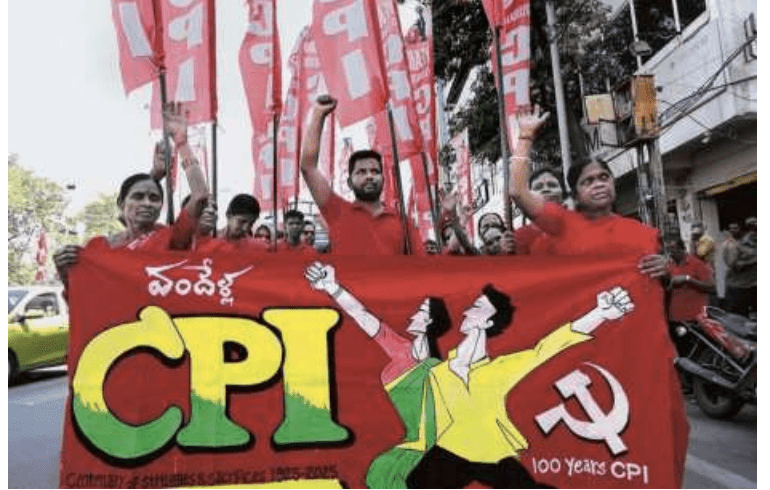
The Communist Party of India (CPI) completed 100 years of its formation on December 26, 2025, marking a century since the Kanpur conference of 1925 formally established the party. The articles reflect on 100 years of CPI, tracing its ideological origins, role in the freedom struggle, mass movements, post-Independence contributions, and its contemporary political relevance.
Origins of Communist Thought (Global Background)
0.1 After the French Revolution (1789) and the Napoleonic Wars, Europe became divided between defenders of monarchy and supporters of republican and democratic change, giving rise to Left–Right politics.
0.2 In the 19th century, industrialisation increased wealth but deepened inequality, creating conditions for socialist and communist ideas to emerge.
0.3 Karl Marx argued that capitalism would be replaced by socialism, though the first successful socialist revolution occurred in Russia (1917).
0.4 The Russian Revolution strongly influenced anti-imperialist movements in colonised countries, including India.
Early Indian Roots of Communism
0.1 Indian revolutionaries encountered Marxism abroad and through international networks, linking national liberation with social emancipation.
0.2 The communist movement in India developed through multiple streams — diaspora revolutionaries, urban Left groups, and workers’ and peasants’ organisations.
0.3 M.N. Roy emerged as a key figure, representing India at the Communist International (Comintern) meeting in 1920.
The Tashkent Phase (1920)
0.1 In 1920, Indian representatives including M.N. Roy participated in a Comintern-backed meeting in Tashkent proposing a Communist party for India.
0.2 The party formed at Tashkent had international approval but limited organisational support inside India.
0.3 This phase highlighted the internationalist character of early Indian communism.
The Kanpur Foundation (1925)
0.1 On December 26, 1925, Indian Communist groups organised a national conference in Kanpur and formally set up the Communist Party of India (CPI).
0.2 The conference aimed at ending British imperial rule and creating a workers’ and peasants’ republic.
0.3 It called for socialisation of the means of production and distribution along with national liberation.
0.4 The Kanpur moment is treated by CPI as its foundation rooted in Indian conditions, central to understanding 100 years of CPI.
Early Activities and Repression (1925–1930s)
0.1 Between 1925 and 1928, Communists organised workers’ and peasants’ parties across India.
0.2 In 1929, leaders were arrested in the Meerut Conspiracy Case, the party was banned, and many were jailed or deported.
0.3 Despite repression, Communists worked within broader anti-imperialist platforms during the 1930s.
Role in the Freedom Struggle
0.1 In the 1930s, Communists participated in a United Front with the Congress Socialist Party and other forces.
0.2 Cooperation weakened by 1939 due to ideological and strategic differences.
0.3 Communists argued that political freedom must be linked with social and economic transformation.
Mass Movements and Social Base
0.1 The CPI built strength through trade unions, peasant movements, student organisations, and cultural associations.
0.2 The All-India Trade Union Congress (AITUC) played a central role in worker mobilisation.
0.3 Peasant struggles in Bengal, Telangana, and Kerala became pillars of Communist politics.
Post-Independence Phase and Internal Debates
0.1 After 1947, Communists debated between armed revolution and parliamentary democracy.
0.2 Strategic differences eventually led to the 1964 split between CPI and CPI(M).
CPI’s Post-Independence Contributions
0.1 The CPI contributed to land reforms, labour rights, and peasant mobilisation in several States.
0.2 It argued that political independence without social justice would perpetuate exploitation.
0.3 Both parliamentary participation and extra-parliamentary struggles were used to advance workers’ interests.
CPI at 100: Legacy and Contemporary Relevance
0.1 100 years of CPI is presented as a moment of reflection centred on democracy, secularism, and social justice.
0.2 The articles note that economic growth has been accompanied by unemployment, precarity, and inequality.
0.3 CPI views its role as defending constitutional values, rebuilding public institutions, and aligning Left politics with popular aspirations.
0.4 The legacy of CPI is shown as a blend of internationalist ideology and Indian social realities, with Kanpur symbolising its roots and Tashkent its global link.
![UPSC coaching in India - Best UPSC coaching institute - UPSC Mentor coaching - UPSC preparation institute - IAS coaching center - UPSC online coaching - Best IAS coaching in India - UPSC classes for beginners - Civil services preparation - IAS preparation institute - UPSC mentorship program - UPSC exam guidance - IAS study material - UPSC Prelims coaching - UPSC Mains coaching - UPSC interview preparation - Best IAS online classes - UPSC coaching with personal mentorship - Affordable UPSC coaching - UPSC test series - UPSC coaching near me - Best IAS coaching near me - UPSC institute in [your city] - IAS coaching center in [your city] - The UPSC Mentor coaching - The UPSC Mentor IAS classes - The UPSC Mentor UPSC course - UPSC Mentor online program.](https://theupscmentor.in/wp-content/uploads/2025/11/cropped-THE-UPSC-1.png)