![http://UPSC%20coaching%20in%20India%20-%20Best%20UPSC%20coaching%20institute%20-%20UPSC%20Mentor%20coaching%20-%20UPSC%20preparation%20institute%20-%20IAS%20coaching%20center%20-%20UPSC%20online%20coaching%20-%20Best%20IAS%20coaching%20in%20India%20-%20UPSC%20classes%20for%20beginners%20-%20Civil%20services%20preparation%20-%20IAS%20preparation%20institute%20-%20UPSC%20mentorship%20program%20-%20UPSC%20exam%20guidance%20-%20IAS%20study%20material%20-%20UPSC%20Prelims%20coaching%20-%20UPSC%20Mains%20coaching%20-%20UPSC%20interview%20preparation%20-%20Best%20IAS%20online%20classes%20-%20UPSC%20coaching%20with%20personal%20mentorship%20-%20Affordable%20UPSC%20coaching%20-%20UPSC%20test%20series%20-%20UPSC%20coaching%20near%20me%20-%20Best%20IAS%20coaching%20near%20me%20-%20UPSC%20institute%20in%20[your%20city]%20-%20IAS%20coaching%20center%20in%20[your%20city]%20-%20The%20UPSC%20Mentor%20coaching%20-%20The%20UPSC%20Mentor%20IAS%20classes%20-%20The%20UPSC%20Mentor%20UPSC%20course%20-%20UPSC%20Mentor%20online%20program.](https://theupscmentor.in/wp-content/uploads/2024/11/THE-UPSC-2-e1762319162137.png)
 admin
admin 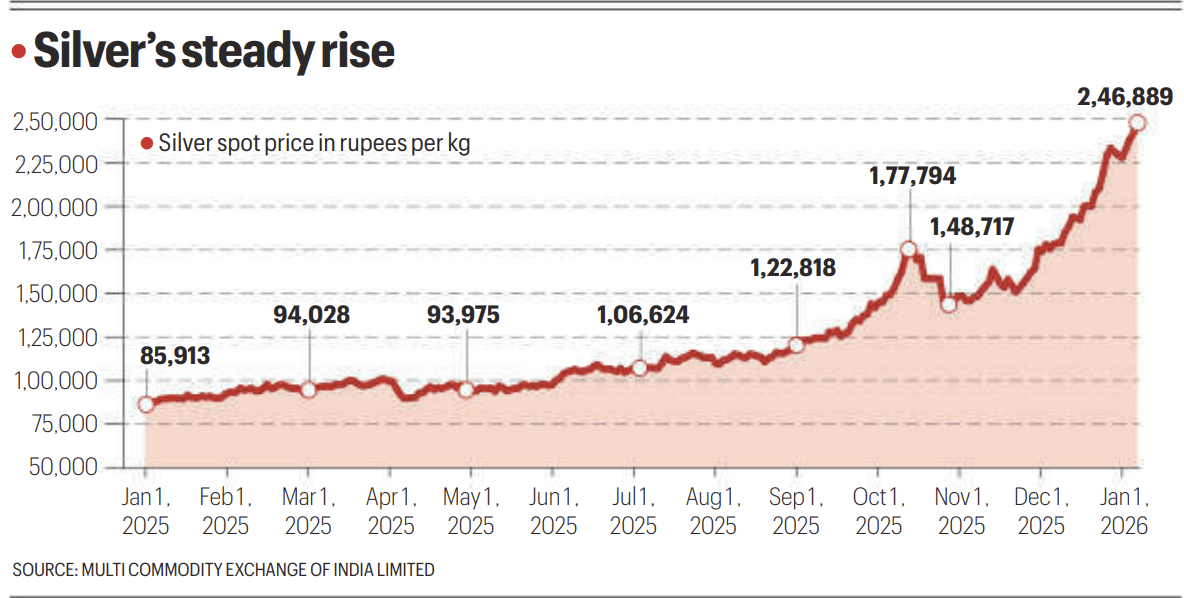
0.1 Scale and timing of the price rise
0.1.1 Silver prices increased by more than 160% during 2025, followed by a further 7% rise in the first week of 2026, showing that the upward trend continued beyond the year.
0.1.2 The increase occurred as a steady rise across the year, rather than a sudden short-term spike.
0.2 Why silver behaved differently from gold
0.2.1 Gold is mainly purchased as a store of value, while silver is used both as an investment and as an industrial input.
0.2.2 Because of this dual role, silver prices respond to manufacturing demand as well as investor behaviour.
0.3 Industrial demand driving silver prices
0.3.1 Silver is an essential material in batteries, solar panels, smart grids, and data transmission systems.
0.3.2 These sectors are expanding and are considered crucial for future economic and technological development, increasing long-term demand for silver.
0.4 Expansion of artificial intelligence–linked demand
0.4.1 Growth in artificial intelligence–related industries has increased the use of silver across a wide range of applications.
0.4.2 Rising investment in AI infrastructure has made AI-linked demand a sustained source of silver consumption.
0.5 Structural limits on silver supply
0.5.1 Silver is largely produced as a by-product of mining other metals, limiting the ability to quickly increase its supply.
0.5.2 As a result, silver supply has remained insufficient relative to rising demand for several years.
0.6 Policy-related supply concerns in the United States
0.6.1 Silver was added to the United States’ critical minerals list in November, increasing its strategic importance.
0.6.2 This raised concerns among users and investors about future trade restrictions, tariffs, and supply security.
0.7 Stockpiling and inventory accumulation
0.7.1 Fear of tariffs led to large-scale stockpiling of silver in the United States.
0.7.2 Inventory levels reached unusually high levels, reducing the quantity of silver available in open markets.
0.8 Impact of China’s export restrictions
0.8.1 China introduced export restrictions on certain rare metals, effective from January 1 for the next two years.
0.8.2 Inclusion of silver in strategic mineral discussions increased global concerns about future supply availability.
0.9 Physical shortage in global price-setting markets
0.9.1 A shortage of physical silver in London emerged by October, affecting global price discovery.
0.9.2 This shortage around Diwali led to sharp price increases as demand exceeded available supply.
1.0 Speculative behaviour and momentum trading
1.0.1 Investors chasing rising gold prices also shifted toward silver, increasing speculative demand.
1.0.2 Retail participation amplified price movements, pushing prices higher.
1.1 Role of exchange-traded funds (ETFs)
1.1.1 Investment in gold and silver ETFs increased as investors sought protection against global market volatility.
1.1.2 Strong inflows into silver ETFs further intensified upward price pressure.
1.2 Reasons for higher silver prices in India
1.2.1 Domestic supply constraints caused silver prices in India to trade at a 5–12% premium over international prices.
1.2.2 This premium reflected limited availability in the local market rather than global price differences.
1.3 Temporary pause by mutual funds
1.3.1 Some mutual funds stopped accepting new lump-sum investments due to sharply elevated prices.
1.3.2 The concern was that investing fresh money at such levels could lead to losses if prices corrected.
1.4 Silver within the broader commodity uptrend
1.4.1 Other metals also experienced strong price rises, with copper crossing a major price milestone.
1.4.2 This indicates that silver’s surge occurred as part of a broader rise in commodity prices.
1.5 Overall understanding
1.5.1 Silver prices rose due to the combined effect of rising industrial demand, supply rigidity, policy-driven fears, physical shortages, and speculative investment.
1.5.2 Although prices surged sharply, high volatility is expected to continue, even as the broader upward trend remains.
![UPSC coaching in India - Best UPSC coaching institute - UPSC Mentor coaching - UPSC preparation institute - IAS coaching center - UPSC online coaching - Best IAS coaching in India - UPSC classes for beginners - Civil services preparation - IAS preparation institute - UPSC mentorship program - UPSC exam guidance - IAS study material - UPSC Prelims coaching - UPSC Mains coaching - UPSC interview preparation - Best IAS online classes - UPSC coaching with personal mentorship - Affordable UPSC coaching - UPSC test series - UPSC coaching near me - Best IAS coaching near me - UPSC institute in [your city] - IAS coaching center in [your city] - The UPSC Mentor coaching - The UPSC Mentor IAS classes - The UPSC Mentor UPSC course - UPSC Mentor online program.](https://theupscmentor.in/wp-content/uploads/2025/11/cropped-THE-UPSC-1.png)