![http://UPSC%20coaching%20in%20India%20-%20Best%20UPSC%20coaching%20institute%20-%20UPSC%20Mentor%20coaching%20-%20UPSC%20preparation%20institute%20-%20IAS%20coaching%20center%20-%20UPSC%20online%20coaching%20-%20Best%20IAS%20coaching%20in%20India%20-%20UPSC%20classes%20for%20beginners%20-%20Civil%20services%20preparation%20-%20IAS%20preparation%20institute%20-%20UPSC%20mentorship%20program%20-%20UPSC%20exam%20guidance%20-%20IAS%20study%20material%20-%20UPSC%20Prelims%20coaching%20-%20UPSC%20Mains%20coaching%20-%20UPSC%20interview%20preparation%20-%20Best%20IAS%20online%20classes%20-%20UPSC%20coaching%20with%20personal%20mentorship%20-%20Affordable%20UPSC%20coaching%20-%20UPSC%20test%20series%20-%20UPSC%20coaching%20near%20me%20-%20Best%20IAS%20coaching%20near%20me%20-%20UPSC%20institute%20in%20[your%20city]%20-%20IAS%20coaching%20center%20in%20[your%20city]%20-%20The%20UPSC%20Mentor%20coaching%20-%20The%20UPSC%20Mentor%20IAS%20classes%20-%20The%20UPSC%20Mentor%20UPSC%20course%20-%20UPSC%20Mentor%20online%20program.](https://theupscmentor.in/wp-content/uploads/2024/11/THE-UPSC-2-e1762319162137.png)
 admin
admin 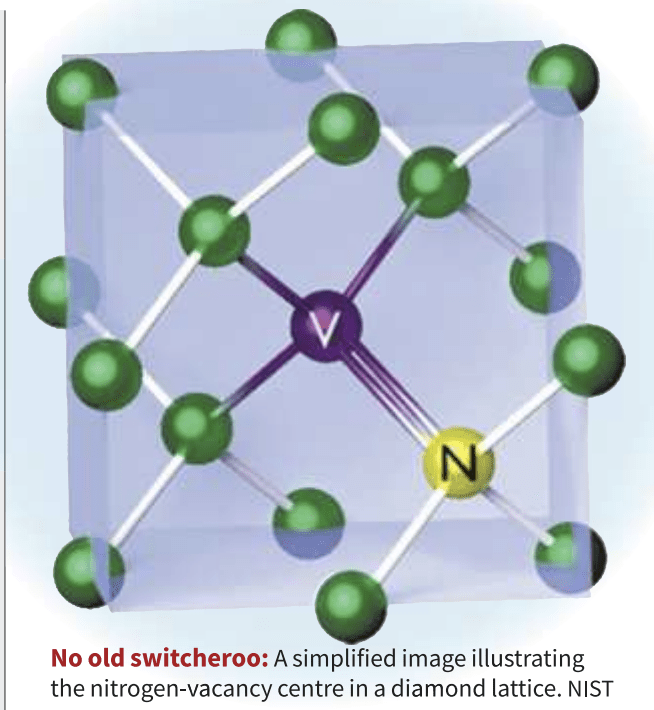
0.1 Why this news matters
0.1.1 Scientists have shown that a defect inside diamonds can be used to create stable quantum systems at room temperature.
0.1.2 This challenges the earlier belief that quantum effects require extremely cold conditions.
0.1.3 The finding opens pathways for new quantum technologies, including ultra-small sensors and a new kind of maser.
0.2 What is the diamond defect being discussed?
0.2.1 The defect is called a nitrogen-vacancy (NV) centre.
0.2.2 It forms when:
- 0.2.2.1 One carbon atom in the diamond lattice is replaced by nitrogen, and
- 0.2.2.2 A neighbouring carbon site is vacant
0.2.3 This defect gives diamonds useful quantum properties.
0.3 Why NV centres are special
0.3.1 NV centres possess a quantum spin that remains coherent even at room temperature.
0.3.2 The diamond lattice shields the spin from environmental noise, preventing loss of quantum information.
0.3.3 Because of this stability, NV centres can act as extremely precise sensors.
0.4 How NV centres interact with light
0.4.1 When illuminated with a green laser, NV centres emit red fluorescence.
0.4.2 The brightness of this light depends on the quantum state (spin) of the NV centre.
0.4.3 This allows scientists to “read” quantum information stored in the diamond.
0.5 The key breakthrough reported
0.5.1 Normally, when many quantum spins are packed together, they interfere with each other, destroying coherence.
0.5.2 Researchers showed that when trillions of NV centres are packed densely:
- 0.5.2.1 Their interactions can be harnessed, not suppressed
- 0.5.2.2 Energy can be transferred cooperatively between spins
0.5.3 This collective behaviour enabled the creation of a continuous microwave emission.
0.6 What is the “superradiant maser”?
0.6.1 A maser is similar to a laser but emits microwaves instead of light.
0.6.2 In this experiment:
- 0.6.2.1 NV centres were placed inside a superconducting microwave cavity
- 0.6.2.2 Spin-spin interactions led to continuous superradiant emission
0.6.3 This is described as a superradiant maser, operating for unusually long durations.
0.7 Why this is important for quantum science
0.7.1 The study identifies spin–spin interactions as a valuable resource rather than a problem.
0.7.2 It improves understanding of many-body quantum systems.
0.7.3 Such systems could enable:
- 0.7.3.1 Ultra-stable frequency sources
- 0.7.3.2 Precision sensing
- 0.7.3.3 Future quantum technologies like time-keeping and measurement devices
![UPSC coaching in India - Best UPSC coaching institute - UPSC Mentor coaching - UPSC preparation institute - IAS coaching center - UPSC online coaching - Best IAS coaching in India - UPSC classes for beginners - Civil services preparation - IAS preparation institute - UPSC mentorship program - UPSC exam guidance - IAS study material - UPSC Prelims coaching - UPSC Mains coaching - UPSC interview preparation - Best IAS online classes - UPSC coaching with personal mentorship - Affordable UPSC coaching - UPSC test series - UPSC coaching near me - Best IAS coaching near me - UPSC institute in [your city] - IAS coaching center in [your city] - The UPSC Mentor coaching - The UPSC Mentor IAS classes - The UPSC Mentor UPSC course - UPSC Mentor online program.](https://theupscmentor.in/wp-content/uploads/2025/11/cropped-THE-UPSC-1.png)