![http://UPSC%20coaching%20in%20India%20-%20Best%20UPSC%20coaching%20institute%20-%20UPSC%20Mentor%20coaching%20-%20UPSC%20preparation%20institute%20-%20IAS%20coaching%20center%20-%20UPSC%20online%20coaching%20-%20Best%20IAS%20coaching%20in%20India%20-%20UPSC%20classes%20for%20beginners%20-%20Civil%20services%20preparation%20-%20IAS%20preparation%20institute%20-%20UPSC%20mentorship%20program%20-%20UPSC%20exam%20guidance%20-%20IAS%20study%20material%20-%20UPSC%20Prelims%20coaching%20-%20UPSC%20Mains%20coaching%20-%20UPSC%20interview%20preparation%20-%20Best%20IAS%20online%20classes%20-%20UPSC%20coaching%20with%20personal%20mentorship%20-%20Affordable%20UPSC%20coaching%20-%20UPSC%20test%20series%20-%20UPSC%20coaching%20near%20me%20-%20Best%20IAS%20coaching%20near%20me%20-%20UPSC%20institute%20in%20[your%20city]%20-%20IAS%20coaching%20center%20in%20[your%20city]%20-%20The%20UPSC%20Mentor%20coaching%20-%20The%20UPSC%20Mentor%20IAS%20classes%20-%20The%20UPSC%20Mentor%20UPSC%20course%20-%20UPSC%20Mentor%20online%20program.](https://theupscmentor.in/wp-content/uploads/2024/11/THE-UPSC-2-e1762319162137.png)
 admin
admin 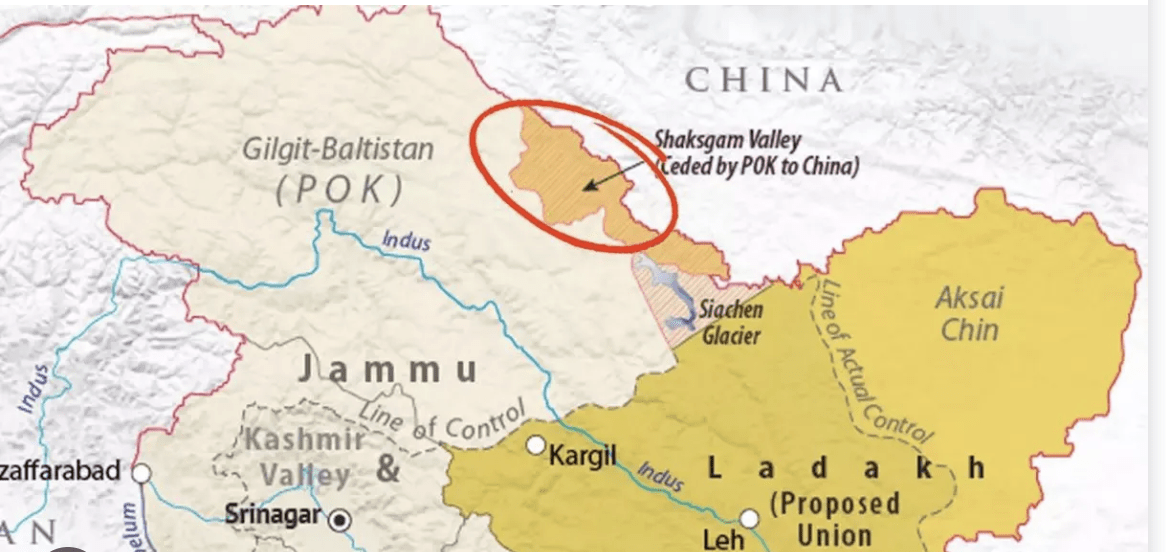
1. Why Shaksgam Valley is back in the news
1.1 The issue resurfaced after a statement by India’s Ministry of External Affairs (MEA), in which India reiterated its claim over Shaksgam Valley.
1.2 In response, a Chinese government spokesperson reaffirmed China’s claim, citing a 1963 boundary agreement with Pakistan.
1.3 China described the agreement as one signed by two sovereign countries, a position India has strongly rejected.
2. India’s official position
2.1 India has stated unequivocally that Shaksgam Valley is Indian territory.
2.2 India has never recognised the 1963 China–Pakistan boundary agreement, calling it illegal and invalid.
2.3 India has also rejected the China–Pakistan Economic Corridor (CPEC), as it passes through Indian territory under illegal Pakistani occupation.
3. Where is Shaksgam Valley?
3.1 Shaksgam Valley, also known as the Trans-Karakoram Tract, lies in the Hunza–Gilgit region, which is occupied by Pakistan.
3.2 It is located north of the Siachen Glacier and covers an area of over 5,000 sq km.
3.3 Due to its harsh terrain and extreme climatic conditions, the region has very limited habitation.
3.4 While India has long claimed the territory, Pakistan exercised control over it until 1963.
4. China’s early strategic interest in the region
4.1 Even before the 1963 agreement, China had begun asserting itself in the broader region.
4.2 In the 1950s, China built a highway connecting Tibet with Xinjiang through Aksai Chin, which India claims as its territory.
4.3 This demonstrated China’s willingness to alter ground realities despite Indian objections.
5. The 1963 China–Pakistan boundary agreement
5.1 The agreement was signed at a time when China–Pakistan relations were deepening, now often described as “ironclad”.
5.2 Despite Pakistan’s alliance with the United States during the Cold War, it sought closer ties with China after the 1962 India–China war.
5.3 Under the agreement, Pakistan ceded around 5,180 sq km of Indian territory in Shaksgam Valley to China.
5.4 India has consistently maintained that Pakistan had no legal right to transfer this territory, as it was itself occupying it illegally.
6. India’s reaction at the time
6.1 The agreement was debated in Indian Parliament.
6.2 Prime Minister Jawaharlal Nehru, on March 5, 1963, expressed concern that the agreement was timed to prejudice talks with Pakistan on Kashmir.
6.3 Nehru stated that while India desired an honourable and equitable settlement, it would not accept proposals that were wrong or unjust.
7. India’s criticism of China’s role
7.1 Nehru criticised China for directly interfering in Indo–Pakistan relations.
7.2 He argued that China was exploiting differences between India and Pakistan on Kashmir.
7.3 According to Nehru, this served China’s expansionist policy rather than regional peace.
8. Breakdown of diplomatic efforts
8.1 An official protest was lodged by India with China.
8.2 Former CIA official Bruce Riedel later noted that the US attempted to encourage compromise between India and Pakistan.
8.3 These efforts failed because Pakistan insisted on territorial settlement, leading to the collapse of talks.
9. India’s position reiterated in recent years
9.1 In 2022, the Indian government stated in the Lok Sabha that China continues to illegally occupy about 38,000 sq km of Indian territory in Ladakh.
9.2 It reiterated that under the 1963 agreement, Pakistan illegally ceded 5,180 sq km of Indian territory in Shaksgam Valley to China.
Conclusion
C.1 Shaksgam Valley represents a long-standing territorial dispute involving India, Pakistan and China.
C.2 India’s position remains firm that the 1963 agreement is illegal and has no validity.
C.3 With the expansion of CPEC and renewed diplomatic assertions, the Shaksgam Valley issue continues to have strategic and geopolitical relevance.
![UPSC coaching in India - Best UPSC coaching institute - UPSC Mentor coaching - UPSC preparation institute - IAS coaching center - UPSC online coaching - Best IAS coaching in India - UPSC classes for beginners - Civil services preparation - IAS preparation institute - UPSC mentorship program - UPSC exam guidance - IAS study material - UPSC Prelims coaching - UPSC Mains coaching - UPSC interview preparation - Best IAS online classes - UPSC coaching with personal mentorship - Affordable UPSC coaching - UPSC test series - UPSC coaching near me - Best IAS coaching near me - UPSC institute in [your city] - IAS coaching center in [your city] - The UPSC Mentor coaching - The UPSC Mentor IAS classes - The UPSC Mentor UPSC course - UPSC Mentor online program.](https://theupscmentor.in/wp-content/uploads/2025/11/cropped-THE-UPSC-1.png)