![http://UPSC%20coaching%20in%20India%20-%20Best%20UPSC%20coaching%20institute%20-%20UPSC%20Mentor%20coaching%20-%20UPSC%20preparation%20institute%20-%20IAS%20coaching%20center%20-%20UPSC%20online%20coaching%20-%20Best%20IAS%20coaching%20in%20India%20-%20UPSC%20classes%20for%20beginners%20-%20Civil%20services%20preparation%20-%20IAS%20preparation%20institute%20-%20UPSC%20mentorship%20program%20-%20UPSC%20exam%20guidance%20-%20IAS%20study%20material%20-%20UPSC%20Prelims%20coaching%20-%20UPSC%20Mains%20coaching%20-%20UPSC%20interview%20preparation%20-%20Best%20IAS%20online%20classes%20-%20UPSC%20coaching%20with%20personal%20mentorship%20-%20Affordable%20UPSC%20coaching%20-%20UPSC%20test%20series%20-%20UPSC%20coaching%20near%20me%20-%20Best%20IAS%20coaching%20near%20me%20-%20UPSC%20institute%20in%20[your%20city]%20-%20IAS%20coaching%20center%20in%20[your%20city]%20-%20The%20UPSC%20Mentor%20coaching%20-%20The%20UPSC%20Mentor%20IAS%20classes%20-%20The%20UPSC%20Mentor%20UPSC%20course%20-%20UPSC%20Mentor%20online%20program.](https://theupscmentor.in/wp-content/uploads/2024/11/THE-UPSC-2-e1762319162137.png)
 admin
admin 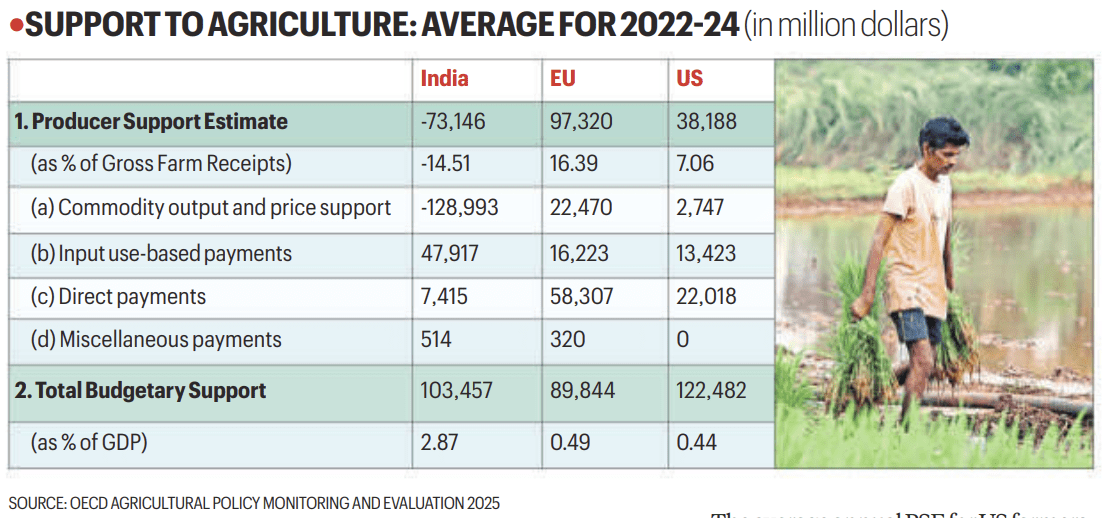
0.1 Context
0.1.1 Agriculture has been a major stumbling block in concluding a Free Trade Agreement (FTA) between India and the US.
0.1.2 India is simultaneously moving towards finalising an FTA with the European Union (EU) that includes agriculture.
0.2 Livelihood Sensitivity of Indian Agriculture
0.2.1 India has 11.8 million farms (Agriculture Census 2024).
0.2.2 A large share of the population depends on farming for livelihoods, making trade liberalisation politically sensitive.
0.2.3 Governments have therefore been cautious about opening agricultural markets to foreign imports.
0.3 Farm Subsidy Concerns in Trade Deals
0.3.1 Trade negotiations are influenced by subsidies given to farmers in partner countries.
0.3.2 The article uses the Producer Support Estimate (PSE) to compare farm support across countries.
0.3.3 PSE measures transfers to farmers through price support, input subsidies and direct payments.
0.4 EU’s Agricultural Support Structure
0.4.1 EU countries provided an average PSE of 16.4% of gross farm receipts (2022–24).
0.4.2 Support is largely through direct payments and market price support.
0.4.3 EU farmers receive substantial protection from international price competition.
0.5 US Agricultural Support Structure
0.5.1 US farmers had an average PSE of 7.1% of gross farm receipts (2022–24).
0.5.2 Support is mainly through input subsidies and commodity price support.
0.5.3 US agricultural exports are highly competitive globally.
0.6 India’s Agricultural Support Pattern
0.6.1 India heavily subsidises inputs such as fertilisers, electricity, irrigation water and credit.
0.6.2 Direct income support to farmers is limited, mainly through schemes like PM-Kisan.
0.6.3 Input subsidies averaged $47.9 billion in 2022–24, among the highest globally.
0.7 Negative Market Price Support in India
0.7.1 Indian farmers often receive prices below international levels due to:
0.7.1.1 Domestic stocking and movement restrictions
0.7.1.2 Export controls
0.7.2 This results in negative commodity price support.
0.7.3 India recorded a negative agricultural PSE, implying net taxation of farmers.
0.8 Implications for Trade Agreements
0.8.1 An FTA with the US could lead to large imports of highly competitive US farm products.
0.8.2 Products highlighted include corn, soybean, ethanol and cotton.
0.8.3 This poses a higher risk to Indian farmers’ incomes.
0.9 Why an EU Deal Is Less Risky
0.9.1 EU agricultural products are not highly competitive in most Indian farm commodities.
0.9.2 Potential EU exports are largely limited to premium products such as cheeses.
0.9.3 This reduces the risk of import surges harming Indian farmers.
0.10 Export Opportunities for India
0.10.1 An EU FTA could benefit India in products where it has strong export interests, including:
0.10.1.1 Seafood (shrimps and prawns)
0.10.1.2 Rice and spices
0.10.1.3 Fruits, vegetables and beverages
0.10.2 India already exports significant agri-products to the EU market.
0.11 Core Argument of the Article
0.11.1 Given subsidy structures, price support systems, and competitiveness of farm products,
0.11.2 An EU trade deal is portrayed as more favourable for Indian farmers than a deal with the US.
![UPSC coaching in India - Best UPSC coaching institute - UPSC Mentor coaching - UPSC preparation institute - IAS coaching center - UPSC online coaching - Best IAS coaching in India - UPSC classes for beginners - Civil services preparation - IAS preparation institute - UPSC mentorship program - UPSC exam guidance - IAS study material - UPSC Prelims coaching - UPSC Mains coaching - UPSC interview preparation - Best IAS online classes - UPSC coaching with personal mentorship - Affordable UPSC coaching - UPSC test series - UPSC coaching near me - Best IAS coaching near me - UPSC institute in [your city] - IAS coaching center in [your city] - The UPSC Mentor coaching - The UPSC Mentor IAS classes - The UPSC Mentor UPSC course - UPSC Mentor online program.](https://theupscmentor.in/wp-content/uploads/2025/11/cropped-THE-UPSC-1.png)