![http://UPSC%20coaching%20in%20India%20-%20Best%20UPSC%20coaching%20institute%20-%20UPSC%20Mentor%20coaching%20-%20UPSC%20preparation%20institute%20-%20IAS%20coaching%20center%20-%20UPSC%20online%20coaching%20-%20Best%20IAS%20coaching%20in%20India%20-%20UPSC%20classes%20for%20beginners%20-%20Civil%20services%20preparation%20-%20IAS%20preparation%20institute%20-%20UPSC%20mentorship%20program%20-%20UPSC%20exam%20guidance%20-%20IAS%20study%20material%20-%20UPSC%20Prelims%20coaching%20-%20UPSC%20Mains%20coaching%20-%20UPSC%20interview%20preparation%20-%20Best%20IAS%20online%20classes%20-%20UPSC%20coaching%20with%20personal%20mentorship%20-%20Affordable%20UPSC%20coaching%20-%20UPSC%20test%20series%20-%20UPSC%20coaching%20near%20me%20-%20Best%20IAS%20coaching%20near%20me%20-%20UPSC%20institute%20in%20[your%20city]%20-%20IAS%20coaching%20center%20in%20[your%20city]%20-%20The%20UPSC%20Mentor%20coaching%20-%20The%20UPSC%20Mentor%20IAS%20classes%20-%20The%20UPSC%20Mentor%20UPSC%20course%20-%20UPSC%20Mentor%20online%20program.](https://theupscmentor.in/wp-content/uploads/2024/11/THE-UPSC-2-e1762319162137.png)
 admin
admin 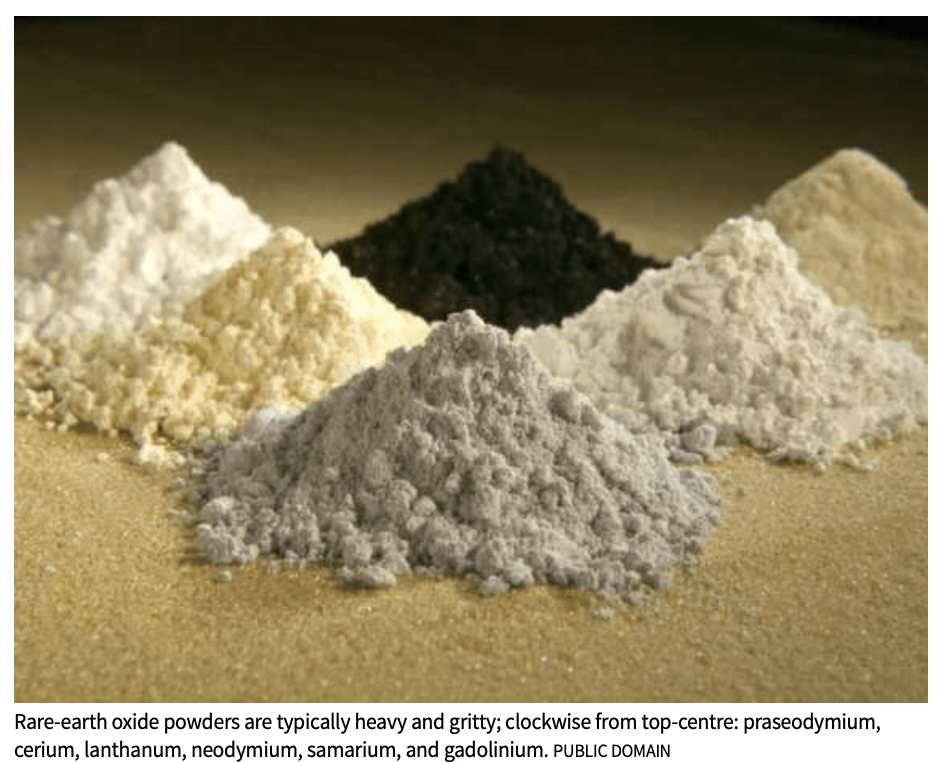
1. What are rare-earth elements
0.1 Rare-earth elements are a group of 17 metallic elements comprising 15 lanthanides (lanthanum to lutetium) along with scandium and yttrium.
0.2 In the periodic table, lanthanides are shown as a separate row, while scandium and yttrium lie in Group 3, above and near transition metals.
0.3 The term ‘earth’ is historical, referring to oxide powders, as many of these elements were first identified as oxides.
2. Why they are called ‘rare’
0.4 Rare-earth elements are not very scarce in the earth’s crust, but occur in low concentrations.
0.5 They are usually mixed together within the same minerals, making them difficult and expensive to separate.
0.6 The term ‘rare earths’ is often used loosely, sometimes wrongly including lithium, cobalt, gallium, and germanium, which are not rare-earth elements.
3. Geological occurrence and mining
0.7 Economically viable deposits are found in limited pockets of rock and soil, rather than being evenly distributed.
0.8 Mining companies target minerals such as bastnäsite and monazite, which contain higher concentrations of rare-earth elements.
0.9 Most mines are open-pit, requiring large volumes of rock to be dug out, crushed, and moved in bulk.
0.10 Some rare-earth minerals occur alongside thorium or uranium, requiring careful handling of waste rock.
4. Environmental and chemical challenges
0.11 Mining and processing require large quantities of water and specific chemicals to produce an initial concentrate.
0.12 Acids and bases used in processing can generate hazardous waste if not properly treated.
0.13 Radioactive by-products from thorium or uranium make storage and disposal more complex.
5. Extraction and processing stages
0.14 Beneficiation is the first step after mining, involving crushing and grinding to free mineral grains.
0.15 Physical techniques such as flotation, magnets, or gravity separation are used to produce a richer concentrate.
0.16 The concentrate still contains many rare-earth elements together, along with unwanted materials.
6. Chemical separation and refining
0.17 The next stage is chemical cracking, where strong acids, bases, or high temperatures break rare-earth minerals apart.
0.18 Leaching follows, in which cracked material is mixed with a liquid (often acidic) so rare-earth ions dissolve.
0.19 The leach solution contains all rare-earth ions together, making separation the most difficult step.
0.20 Because rare-earth ions have similar size and charge (usually +3), simple chemical reactions cannot separate them.
0.21 Solvent extraction is used, where organic solvents selectively bind certain rare-earth ions more than others.
0.22 The process must be repeated through many stages, as separation differences are very small.
0.23 Final recovery occurs by precipitation, producing solids that are filtered, washed, heated, and stored as rare-earth oxides.
7. Rare-earth elements vs crude oil processing
0.24 Both rare-earth elements and crude oil must be extracted and processed before use.
0.25 Oil refining relies mainly on physical separation, such as fractional distillation based on boiling points.
0.26 Rare-earth refining relies on complex chemical separation, making it more energy- and process-intensive.
8. Magnetic properties and applications
0.27 Rare-earth atoms have 4f electrons that are highly localised and carry large magnetic moments.
0.28 These electrons align strongly due to magnetocrystalline anisotropy, making magnets stable against heat and vibrations.
0.29 Neodymium-iron-boron magnets, containing rare-earth elements, are used in motors and generators and work efficiently at high speeds and temperatures.
9. Optical and electronic applications
0.30 Rare-earth elements are effective phosphors, producing sharp and stable colours.
0.31 Elements such as europium and terbium are used in lighting, while neodymium and erbium are used in lasers and fibre optics.
0.32 Their light emission occurs at fixed frequencies, rather than a mix of colours, due to 4f electron behaviour.
10. Other industrial uses
0.33 Rare-earth elements are used in catalysts, glass and ceramics, polishing powders, and other specialised materials.
0.34 These applications rely on their electrical, magnetic, and optical properties.
11. China’s dominance in the value chain
0.35 A country may have large deposits but still depend on others if it lacks separation and refining capacity.
0.36 According to the U.S. Geological Survey, global reserves exceed 90 million tonnes of rare-earth oxide equivalent, excluding scandium.
0.37 Major reserves are located in China, Brazil, India, Australia, Russia, Vietnam, the U.S., and Greenland.
0.38 China dominates the midstream stage, accounting for about 91% of global separation and refining.
0.39 China also produces around 94% of sintered rare-earth permanent magnets globally.
12. Strategic importance today
0.40 Many green technologies depend on motors, generators, and high-performance magnets, increasing demand for rare-earth elements.
0.41 Countries are focusing on building refining and magnet-making capacity, not just approving new mines.
![UPSC coaching in India - Best UPSC coaching institute - UPSC Mentor coaching - UPSC preparation institute - IAS coaching center - UPSC online coaching - Best IAS coaching in India - UPSC classes for beginners - Civil services preparation - IAS preparation institute - UPSC mentorship program - UPSC exam guidance - IAS study material - UPSC Prelims coaching - UPSC Mains coaching - UPSC interview preparation - Best IAS online classes - UPSC coaching with personal mentorship - Affordable UPSC coaching - UPSC test series - UPSC coaching near me - Best IAS coaching near me - UPSC institute in [your city] - IAS coaching center in [your city] - The UPSC Mentor coaching - The UPSC Mentor IAS classes - The UPSC Mentor UPSC course - UPSC Mentor online program.](https://theupscmentor.in/wp-content/uploads/2025/11/cropped-THE-UPSC-1.png)