![http://UPSC%20coaching%20in%20India%20-%20Best%20UPSC%20coaching%20institute%20-%20UPSC%20Mentor%20coaching%20-%20UPSC%20preparation%20institute%20-%20IAS%20coaching%20center%20-%20UPSC%20online%20coaching%20-%20Best%20IAS%20coaching%20in%20India%20-%20UPSC%20classes%20for%20beginners%20-%20Civil%20services%20preparation%20-%20IAS%20preparation%20institute%20-%20UPSC%20mentorship%20program%20-%20UPSC%20exam%20guidance%20-%20IAS%20study%20material%20-%20UPSC%20Prelims%20coaching%20-%20UPSC%20Mains%20coaching%20-%20UPSC%20interview%20preparation%20-%20Best%20IAS%20online%20classes%20-%20UPSC%20coaching%20with%20personal%20mentorship%20-%20Affordable%20UPSC%20coaching%20-%20UPSC%20test%20series%20-%20UPSC%20coaching%20near%20me%20-%20Best%20IAS%20coaching%20near%20me%20-%20UPSC%20institute%20in%20[your%20city]%20-%20IAS%20coaching%20center%20in%20[your%20city]%20-%20The%20UPSC%20Mentor%20coaching%20-%20The%20UPSC%20Mentor%20IAS%20classes%20-%20The%20UPSC%20Mentor%20UPSC%20course%20-%20UPSC%20Mentor%20online%20program.](https://theupscmentor.in/wp-content/uploads/2024/11/THE-UPSC-2-e1762319162137.png)
 admin
admin 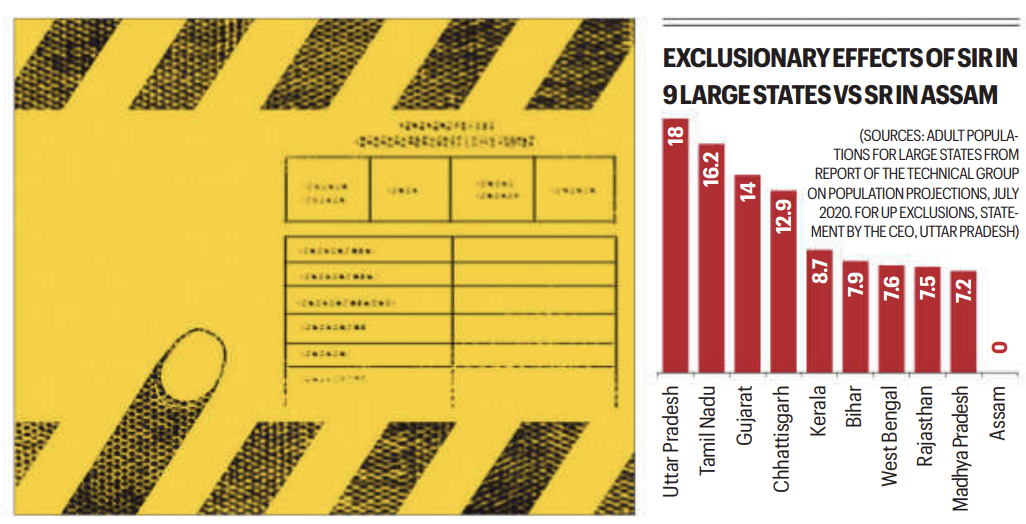
Context
0.1 The article examines the Special Intensive Revision (SIR) of electoral rolls and argues that its design itself leads to large-scale voter exclusion.
0.2 This claim is supported through real-world comparisons described as “natural experiments”, arising unintentionally across states and election types.
What is meant by ‘natural experiment’
0.3 A natural experiment refers to situations where different methods are applied to comparable populations, enabling outcome comparison without deliberate design.
0.4 In this case, SIR-based voter revision is compared with non-SIR revision methods applied to the same or similar electorates.
First natural experiment: Bihar
0.5 During SIR in Bihar, draft electoral rolls initially showed the deletion of around 65 lakh voters.
0.6 After Supreme Court–mandated corrective measures, net deletions were reduced to about 44 lakh names.
0.7 The scale of deletions could not be explained by migration alone, pointing to procedural issues within SIR.
Why Bihar raised early concern
0.8 Bihar does not exhibit unusually high out-migration compared to several other states.
0.9 Despite this, the sharp contraction in the voter list suggested that SIR procedures, rather than demographic change, drove deletions.
Second natural experiment: Assam
0.10 In Assam, two electoral exercises were conducted for the same population:
– Assembly elections using SIR, and
– Panchayat elections conducted without enumeration forms or citizenship proof requirements.
0.11 Panchayat voter lists did not show mass deletions, unlike the SIR-based Assembly rolls.
0.12 This contrast indicates that absence of SIR requirements prevented large-scale disenfranchisement.
Evidence from Uttar Pradesh
0.13 Uttar Pradesh provides a direct comparison where two methods yielded different voter counts:
– SIR method listed rural voters at 12.6 crore,
– Non-SIR method listed 16.1 crore voters, aligning with projected adult population.
0.14 Since both counts refer to the same population, the variation arises solely from the method employed.
What “method becomes the causal factor” means
0.15 The phrase implies that voter exclusion occurs because of SIR’s design, not due to migration, death, or ineligibility.
0.16 When altering only the revision method drastically changes voter numbers, the method itself causes exclusion.
All-India pattern
0.17 Data from 12 states and Union Territories show that SIR-led revisions excluded about 6.56 crore voters nationwide.
0.18 This closely aligns with earlier estimates, confirming that the issue is systemic rather than state-specific.
Design features identified as problematic
0.19 Two compulsory features of SIR are highlighted:
– Mandatory enumeration forms, and
– Requirement of proof of citizenship.
0.20 These shift the burden of proof onto voters, many of whom are unable to comply.
Who is most affected
0.21 Exclusions disproportionately affect women, the poor, migrants, and marginalised groups.
0.22 This is reflected in a decline in gender ratios within voter lists after SIR across multiple states.
![UPSC coaching in India - Best UPSC coaching institute - UPSC Mentor coaching - UPSC preparation institute - IAS coaching center - UPSC online coaching - Best IAS coaching in India - UPSC classes for beginners - Civil services preparation - IAS preparation institute - UPSC mentorship program - UPSC exam guidance - IAS study material - UPSC Prelims coaching - UPSC Mains coaching - UPSC interview preparation - Best IAS online classes - UPSC coaching with personal mentorship - Affordable UPSC coaching - UPSC test series - UPSC coaching near me - Best IAS coaching near me - UPSC institute in [your city] - IAS coaching center in [your city] - The UPSC Mentor coaching - The UPSC Mentor IAS classes - The UPSC Mentor UPSC course - UPSC Mentor online program.](https://theupscmentor.in/wp-content/uploads/2025/11/cropped-THE-UPSC-1.png)