![http://UPSC%20coaching%20in%20India%20-%20Best%20UPSC%20coaching%20institute%20-%20UPSC%20Mentor%20coaching%20-%20UPSC%20preparation%20institute%20-%20IAS%20coaching%20center%20-%20UPSC%20online%20coaching%20-%20Best%20IAS%20coaching%20in%20India%20-%20UPSC%20classes%20for%20beginners%20-%20Civil%20services%20preparation%20-%20IAS%20preparation%20institute%20-%20UPSC%20mentorship%20program%20-%20UPSC%20exam%20guidance%20-%20IAS%20study%20material%20-%20UPSC%20Prelims%20coaching%20-%20UPSC%20Mains%20coaching%20-%20UPSC%20interview%20preparation%20-%20Best%20IAS%20online%20classes%20-%20UPSC%20coaching%20with%20personal%20mentorship%20-%20Affordable%20UPSC%20coaching%20-%20UPSC%20test%20series%20-%20UPSC%20coaching%20near%20me%20-%20Best%20IAS%20coaching%20near%20me%20-%20UPSC%20institute%20in%20[your%20city]%20-%20IAS%20coaching%20center%20in%20[your%20city]%20-%20The%20UPSC%20Mentor%20coaching%20-%20The%20UPSC%20Mentor%20IAS%20classes%20-%20The%20UPSC%20Mentor%20UPSC%20course%20-%20UPSC%20Mentor%20online%20program.](https://theupscmentor.in/wp-content/uploads/2024/11/THE-UPSC-2-e1762319162137.png)
 admin
admin 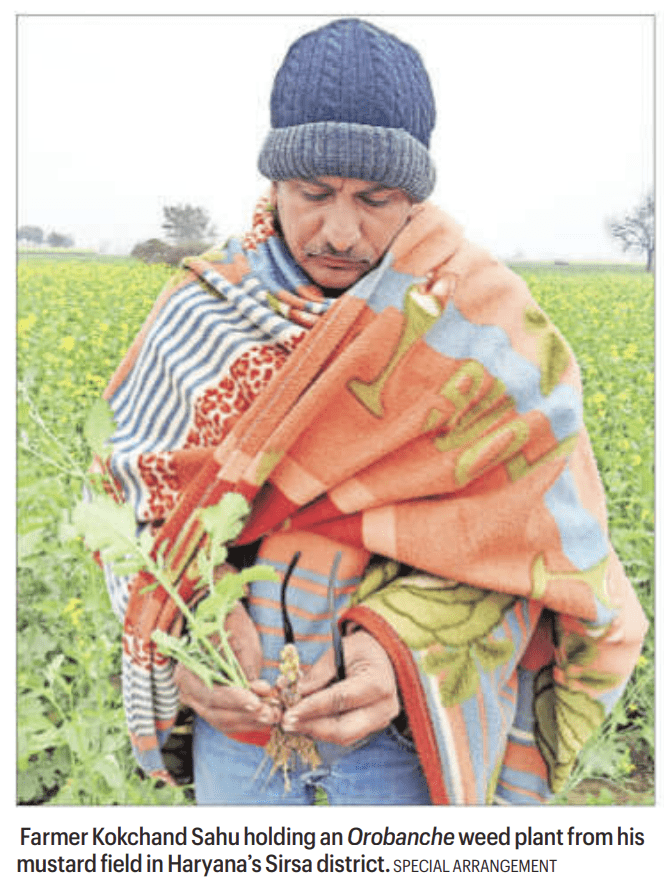
0.1 Why this issue matters
0.1.1 Mustard is India’s largest indigenous edible oil crop, grown on nearly nine million hectares across Rajasthan, UP, MP, Haryana, and West Bengal.
0.1.2 Rising infestation of Orobanche aegyptiaca (parasitic weed) threatens yields, farmer confidence, and edible oil self-reliance.
0.1.3 Yield losses directly affect India’s effort to reduce edible oil imports, valued at over $18 billion annually.
0.2 Nature of the weed threat (Orobanche / Margoja)
0.2.1 Orobanche is a root parasite that attaches underground to mustard roots and extracts nutrients, carbon, and water.
0.2.2 Damage occurs before the parasite emerges above ground, making early detection difficult.
0.2.3 Effects include wilting, yellowing, stunted growth, and significant reduction in mustard seed yields.
0.3 Why Orobanche spreads rapidly
0.3.1 A single Orobanche shoot produces 40–45 flowers, each with 4,000–5,000 minute seeds.
0.3.2 Seeds remain viable in soil for up to 20 years and spread through wind and irrigation water.
0.3.3 First irrigation (25–30 days after sowing) creates moist conditions ideal for seed germination and root attachment.
0.4 Evidence from farmers’ experiences
0.4.1 Farmers in Sirsa (Haryana) report a shift from 9–12 quintals/acre earlier to as low as 6 quintals/acre.
0.4.2 Many farmers are reducing mustard acreage and shifting to wheat, chana, or jau due to declining confidence.
0.4.3 Repeated mustard cultivation increases parasite density, worsening infestation in subsequent seasons.
0.5 Why herbicides are not a simple solution
0.5.1 Glyphosate inhibits the EPSPS enzyme, essential for all plants, including crops.
0.5.2 Non-selective herbicides like glyphosate, paraquat, and imazapyr kill both mustard and the weed.
0.5.3 Recommended glyphosate doses are too low to block EPSPS effectively in Orobanche.
0.6 Mustard’s national economic importance
0.6.1 Mustard contributes over 4 million tonnes to India’s 10.5–10.6 mt annual indigenous edible oil production.
0.6.2 It is a target crop for yield improvement to reduce dependence on palm, soybean, and sunflower imports.
0.6.3 Rising vulnerability to weeds and pests makes productivity gains uncertain.
0.7 Breeding-based solution: herbicide-tolerant mustard
0.7.1 Hybrid ‘Pioneer-45S42CL’ tolerates imidazolinone herbicides (imazapyr and imazapic).
0.7.2 These herbicides kill Orobanche without harming mustard plants.
0.7.3 The resistance trait has been introduced through a non-GM route.
0.8 Field-level outcomes reported
0.8.1 Farmers applying ‘Kifix’ (imazapyr + imazapic) report effective control of margoja after 25 days.
0.8.2 Cost is around ₹3,150 per acre, with two packs sufficient per acre.
0.8.3 Early adopters report restored confidence and normal harvest timelines (130–150 days).
0.9 Scientific follow-up efforts
0.9.1 Delhi University researchers are developing mustard lines with glyphosate and imidazolinone resistance.
0.9.2 Genes like cp4 epsps and als are being tested to control Orobanche.
0.9.3 Aim is long-term control through early emergence prevention and seed-bank depletion.
0.10 Core takeaway
0.10.1 Orobanche represents a hidden but systemic threat to mustard cultivation.
0.10.2 Chemical control alone is ineffective without crop tolerance.
0.10.3 Herbicide-resistant mustard hybrids, if scaled responsibly, offer a viable path to protect yields and edible oil security.
![UPSC coaching in India - Best UPSC coaching institute - UPSC Mentor coaching - UPSC preparation institute - IAS coaching center - UPSC online coaching - Best IAS coaching in India - UPSC classes for beginners - Civil services preparation - IAS preparation institute - UPSC mentorship program - UPSC exam guidance - IAS study material - UPSC Prelims coaching - UPSC Mains coaching - UPSC interview preparation - Best IAS online classes - UPSC coaching with personal mentorship - Affordable UPSC coaching - UPSC test series - UPSC coaching near me - Best IAS coaching near me - UPSC institute in [your city] - IAS coaching center in [your city] - The UPSC Mentor coaching - The UPSC Mentor IAS classes - The UPSC Mentor UPSC course - UPSC Mentor online program.](https://theupscmentor.in/wp-content/uploads/2025/11/cropped-THE-UPSC-1.png)