![http://UPSC%20coaching%20in%20India%20-%20Best%20UPSC%20coaching%20institute%20-%20UPSC%20Mentor%20coaching%20-%20UPSC%20preparation%20institute%20-%20IAS%20coaching%20center%20-%20UPSC%20online%20coaching%20-%20Best%20IAS%20coaching%20in%20India%20-%20UPSC%20classes%20for%20beginners%20-%20Civil%20services%20preparation%20-%20IAS%20preparation%20institute%20-%20UPSC%20mentorship%20program%20-%20UPSC%20exam%20guidance%20-%20IAS%20study%20material%20-%20UPSC%20Prelims%20coaching%20-%20UPSC%20Mains%20coaching%20-%20UPSC%20interview%20preparation%20-%20Best%20IAS%20online%20classes%20-%20UPSC%20coaching%20with%20personal%20mentorship%20-%20Affordable%20UPSC%20coaching%20-%20UPSC%20test%20series%20-%20UPSC%20coaching%20near%20me%20-%20Best%20IAS%20coaching%20near%20me%20-%20UPSC%20institute%20in%20[your%20city]%20-%20IAS%20coaching%20center%20in%20[your%20city]%20-%20The%20UPSC%20Mentor%20coaching%20-%20The%20UPSC%20Mentor%20IAS%20classes%20-%20The%20UPSC%20Mentor%20UPSC%20course%20-%20UPSC%20Mentor%20online%20program.](https://theupscmentor.in/wp-content/uploads/2024/11/THE-UPSC-2-e1762319162137.png)
 admin
admin 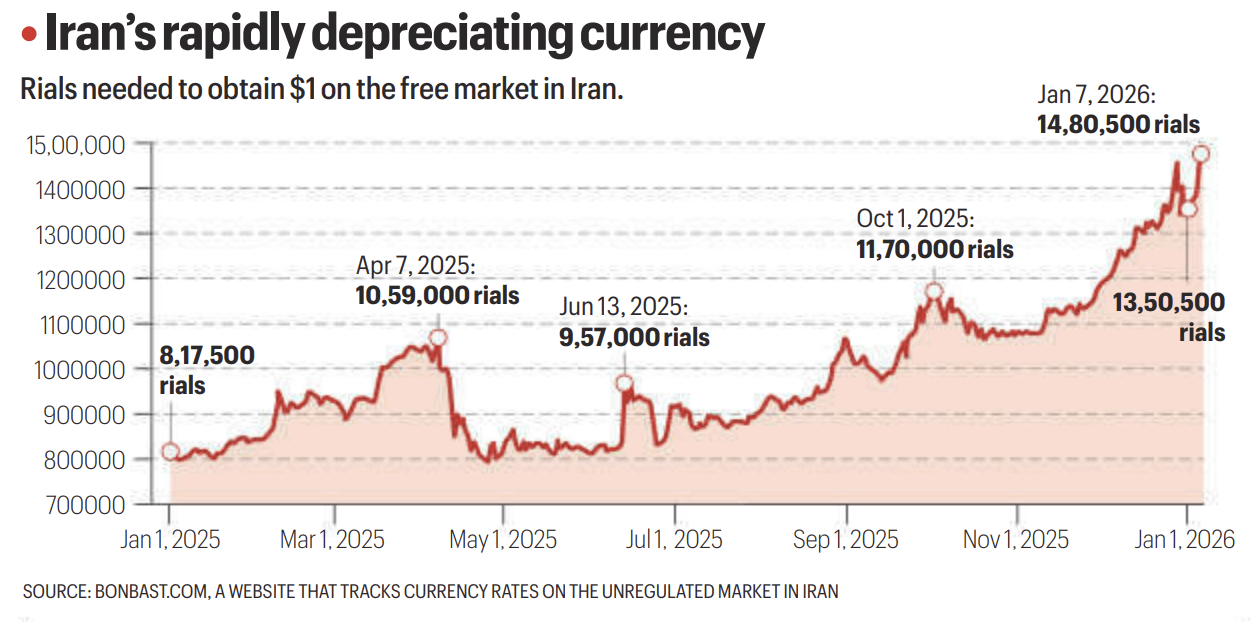
0.1 Nature of the current unrest
0.1.1 Iran is witnessing its largest protest wave in nearly three years, spreading across provinces.
0.1.2 Protests began over cost of living but have quickly turned anti-regime, reflecting deeper political anger.
0.1.3 Demonstrations started in December 2025, led initially by merchants in Tehran’s Grand Bazaar.
0.1.4 Security crackdowns have resulted in at least 36 deaths so far.
0.2 Severe inflation and cost-of-living crisis
0.2.1 Overall inflation rose from around 30% to over 52% during 2025.
0.2.2 Food inflation reached nearly 70%, directly affecting daily survival.
0.2.3 Inflation has sharply reduced purchasing power for a large section of the population.
0.3 Collapse of the Iranian rial (key data)
0.3.1 The rial lost more than half its value within a year.
0.3.2 Exchange rate moved from 8,17,500 rials per dollar (Jan 2025) to 14,80,500 rials (Jan 2026).
0.3.3 This currency collapse has intensified inflation and public anger.
0.4 Government’s economic response
0.4.1 On January 5, the government announced economic reforms to stabilise the situation.
0.4.2 Measures included ending subsidies on essential imports.
0.4.3 The state introduced cash and voucher transfers of about $7 per month, reflecting limited fiscal space.
0.5 Why economic protests become political in Iran
0.5.1 Historically, economic hardship has repeatedly triggered mass protests in Iran.
0.5.2 In recent years, economic distress has merged with anger against authoritarian governance.
0.5.3 As a result, even economic demonstrations rapidly acquire anti-regime character.
0.6 Role of the security apparatus
0.6.1 The regime’s survival depends heavily on the Islamic Revolutionary Guard Corps (IRGC).
0.6.2 The IRGC enjoys economic privileges and institutional power, unlike ordinary citizens.
0.6.3 This makes internal defection unlikely and strengthens regime resilience.
0.7 Comparison with earlier protest waves
0.7.1 The 2009 protests followed disputed elections (Mir Hossein Mousavi).
0.7.2 The 2022–23 protests were triggered by the killing of Mahsa Amini.
0.7.3 Unlike earlier movements driven by social or political triggers, recent protests are primarily economic.
0.8 External pressures and geopolitics
0.8.1 US and UN sanctions linked to Iran’s nuclear programme have worsened economic stress.
0.8.2 The revival of maximum pressure under Donald Trump’s second term intensified the crisis.
0.8.3 Regionally, Iran’s influence has weakened due to setbacks in Syria and Hezbollah’s position in Lebanon.
0.9 Why regime change remains unlikely
0.9.1 Protests remain leaderless and poorly organised.
0.9.2 The IRGC continues to back the regime, limiting chances of systemic change.
0.9.3 Experts argue Iran faces instability and pressure, but not imminent regime collapse.
![UPSC coaching in India - Best UPSC coaching institute - UPSC Mentor coaching - UPSC preparation institute - IAS coaching center - UPSC online coaching - Best IAS coaching in India - UPSC classes for beginners - Civil services preparation - IAS preparation institute - UPSC mentorship program - UPSC exam guidance - IAS study material - UPSC Prelims coaching - UPSC Mains coaching - UPSC interview preparation - Best IAS online classes - UPSC coaching with personal mentorship - Affordable UPSC coaching - UPSC test series - UPSC coaching near me - Best IAS coaching near me - UPSC institute in [your city] - IAS coaching center in [your city] - The UPSC Mentor coaching - The UPSC Mentor IAS classes - The UPSC Mentor UPSC course - UPSC Mentor online program.](https://theupscmentor.in/wp-content/uploads/2025/11/cropped-THE-UPSC-1.png)